I.The Cases That Defined the Landscape
The risks of unverified AI output in legal proceedings are no longer theoretical. A body of case law has now accumulated across multiple jurisdictions that establishes both the fact of the problem and its professional consequences. Whereas the structural liability gap referred to in the first article was considered a theoretical problem in the past, it is now becoming a practical issue in judicial processes. Courts are no longer focused on speculative risks posed by AI systems; rather, they are addressing concrete instances where fabricated citations and fabricated cases have found their way into courtrooms. What was considered experimental only a short time ago is now becoming a legal and professional reality.
The foundational case is Mata v. Avianca, Inc., decided by the United States District Court for the Southern District of New York on 22 June 2023. Attorneys submitted an opposition brief containing multiple non-existent legal precedents generated by ChatGPT. Judge P. Kevin Castel imposed sanctions, characterising the reliance on AI without verification as “poor and sloppy research” [1]. Indeed, it became clear quite quickly that Mata was not going to remain an isolated case. It established a principle that would later emerge across several jurisdictions: the use of technology to generate legal information does not relieve lawyers of their professional responsibility to verify the accuracy of the material before using it. The issue was not the technology itself, but the absence of proper professional judgment surrounding its use.
Since Mata, courts have not grown more lenient. In Johnson v. Dunn (2025), a law firm was disqualified after submitting AI-generated hallucinated citations. These early American cases became particularly influential because they provided one of the first judicial frameworks for addressing AI-assisted misconduct in legal practice. Only later did similar concerns begin emerging more visibly in other jurisdictions such as Australia, England, and France. What stands out most is how rapidly judicial tolerance appears to be narrowing. In the early stages, incidents involving misuse of AI were often treated as cautionary lessons associated with a new technology. More recent judicial responses suggest a different approach, where legal professionals are increasingly expected to understand both the capabilities and the limitations of AI tools before integrating them into legal work [2]. Ignorance of a tool’s limitations is no defence to professional misconduct. Courts across multiple jurisdictions have now made this explicit.
This may ultimately become one of the foundational principles of AI-assisted legal practice. The liability gap is no longer simply an abstract discussion about emerging technologies; it is progressively becoming part of professional ethics and legal responsibility itself.
II. The Professional Responsibility Framework: Who Is Liable?
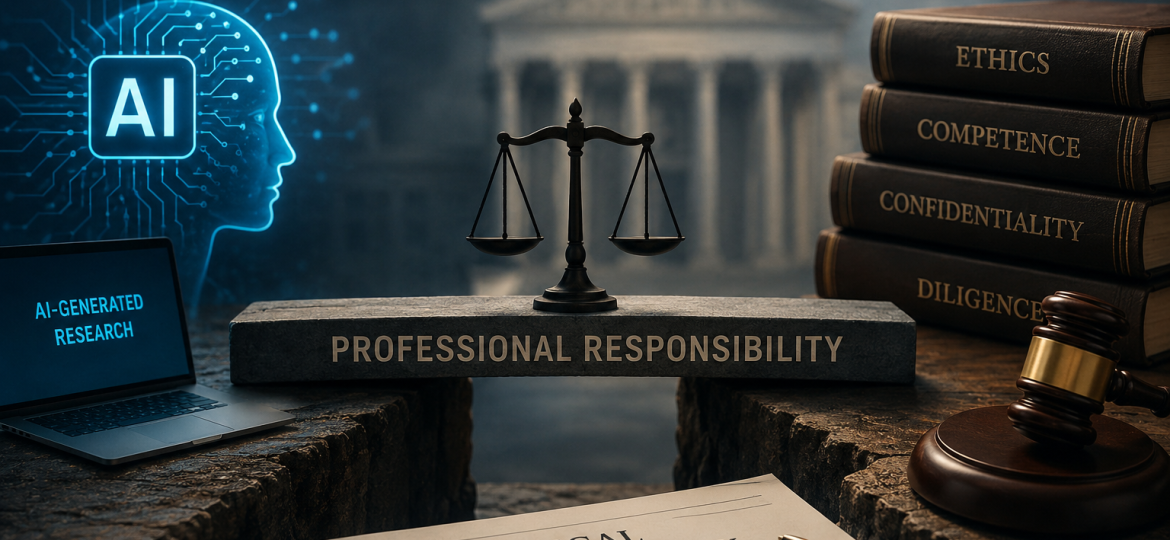
When an LLM-generated legal output causes harm, whether through fabricated citations or incorrect advice, the question of liability must be answered within existing professional responsibility frameworks. Despite being highly innovative, the regulatory reaction from most states has remained quite conservative and orthodox. Rather than formulating any innovative liability principles, regulators often turn to existing legal codes of ethics, professional standards of competence, and supervisory responsibilities. As always, responsibility remains that of the human professional.
Legal ethics codes, such as those of the American Bar Association, require competence, supervision, and verification. These obligations apply equally when AI tools are used [2]. It is not so much that there is a change in the existence of these duties but rather that the scope of these duties changes. Lawyers have to be informed about how AI systems work, their limitations, and the validation of the results produced. Lawyers need not have technical skills but should exercise discretion with regard to AI outputs. The American Bar Association’s Formal Opinion 512 (2024) clarified that competence includes a reasonable understanding of AI tools and their risks. Uncritical reliance on AI-generated content constitutes a breach of professional duty [4].
This demonstrates a trend that is emerging in many other fields as well. The literacy of AI technology is slowly becoming part of professional literacy. Given the increasing application of these technologies in professional settings, ignorance of their powers might become a disadvantage in the very near future. Under supervisory rules, the lawyer who signs a filing remains fully responsible for its content, regardless of how it was produced. This is critical in view of the fact that although AI technology can help draft, summarize, or conduct research, the duty remains where it has always been placed. Signing off the document to file shows that the individual accepts his/her duty. Through this process, AI changes the mode of production without changing the thing itself.
Confidentiality obligations also apply. Submitting client information to AI tools may expose sensitive data, creating additional ethical risks. However, the issue extends beyond ordinary confidentiality obligations. Legal systems also recognize lawyer-client privilege, which protects communications made for the purpose of obtaining legal advice. If privileged information is entered into external AI systems without adequate safeguards, questions may arise regarding waiver, unauthorized disclosure, or loss of privilege protection itself. This adds yet another dimension to the debate. Liability is not only about incorrect citations or incorrect outputs generated by the AI system. This problem is related to what happens to the information when it is processed and possibly saved elsewhere. With increasing use of these technologies in the context of legal work, there may be more attention paid to privacy issues. Failures in these areas may lead to malpractice claims, disciplinary action, and insurance challenges, as coverage for AI-related risks remains limited.
The repercussions, however, go beyond mere embarrassment or punishment from the law. It can even lead to exposure of a business to financial and logistical risks, especially with insurers and regulators now looking anew at AI liabilities.
III. The Global Regulatory Landscape: Fragmentation and Lag
Jurisdictions differ in how they address AI-related liability. The EU AI Act introduces obligations for high-risk systems, while other countries rely on existing legal frameworks [5]. Although the AI Act is not specifically designed for legal malpractice, it remains relevant because certain AI systems used in legal services may fall within broader categories of high-risk applications, particularly where they influence access to justice, legal interpretation, or decision-making processes.
The international regulatory environment still faces fragmentation issues. While some nations try to develop their own AI regulatory structures, there are also those that keep relying on the existing traditional legal models despite all emerging technological changes. The EU approach is therefore significant because it attempts to regulate AI from a systemic perspective rather than relying solely on post-harm judicial intervention.
India presents a distinct case, with rapid adoption of AI tools but limited formal guidance for legal professionals. There is certainly an increasing trend towards this in many developing digital economies where the adoption process is exceeding the regulatory aspect. Although the use of AI technology is currently being applied in the legal sector, there are no regulations that govern its implementation. Therefore, the legal practitioner could find themselves operating within an implied standard of practice.
Courts have begun to address this gap through warnings and sanctions, but judicial intervention remains reactive rather than systematic. The judgment that is delivered by the court plays an important role in determining the boundary, but this takes place too late since damage has been done at this point. The judgment is a response to the problem and not a prediction. It will play an important role in proving the need for codes.
Other jurisdictions, including the United States, the United Kingdom, Singapore, and France, have issued guidance on AI use in legal practice, creating a contrast with less formalized environments [3]. In due course, such distinctions may affect how legal systems embrace AI technologies in their specific domains. Some legal regimes are designing governance structures, while others continue to depend on piecemeal judicial rulings.
IV. Closing the Gap: Toward a Responsible Framework
The liability gap is not permanent. It reflects a lag between technological adoption and regulatory adaptation. In fact, it is very likely that this is going to be the most important factor. The current situation can be termed as one of transition wherein technology advances much faster than institutions. This imbalance has occurred before during past technological revolutions, but not with such rapidity. A responsible framework requires clear principles: verification, transparency, and data governance [3]. Verification would still remain a priority. Although the outcome generated by artificial intelligence may be useful for undertaking legal actions, it should never substitute professional verification. Transparency would be another aspect to consider, particularly if there were any chances that such AI-generated information could influence either the client or the trial. Firms would require setting up their own system of handling the process internally. Institutional guidance from professional bodies is essential to clarify these obligations and ensure consistent standards. Without such clarity, there might be an issue of inconsistent comprehension concerning the matter of responsibility. It will be necessary to establish consistency not only in terms of accountability but also in regard to the legal system itself. AI can enhance legal work, but it cannot replace professional judgment, verification, and accountability. This notion will remain the very foundation of our discussion moving forward. Even though the application of AI could completely transform the delivery of legal services, accountability will forever be in human hands. The liability gap will close. The question is whether it closes through proactive governance or through sanctions and client harm. It may be the decisions we make in the years ahead that decide how much we trust artificial intelligence in the realm of law.
References
[1] Mata v. Avianca, Inc., 2023 (U.S. District Court, S.D.N.Y.)
[2] American Bar Association, Model Rules of Professional Conduct, Rule 1.1 and Rule 5.3 https://www.americanbar.org
[3] OECD, AI Principles and Risk Management Framework, 2023 https://www.oecd.org/ai
[4] American Bar Association, Formal Opinion 512: Generative Artificial Intelligence Tools, 2024 https://www.americanbar.org
[5] European Union, EU Artificial Intelligence Act, 2024 https://artificialintelligenceact.eu/