The adoption of Artificial Intelligence (AI) at scale seems to face two main bottlenecks: energy cost and democracy.
Tim Fist, Director of Emerging Technology Policy at the Institute for Progress, said that we are “roughly looking at tripling the amount of power used for data centers over the next five years, just coming from AI.”¹
The current global data center annual power consumption sits at around 40 gigawatts of installed electric capacity, but by 2030, he said AI data centers alone will require an additional 120 gigawatts, totaling about 160 gigawatts—just over half of Germany’s entire installed power generation capacity in 2023.² Other estimates also show that data center electricity demand could rise fivefold in the next decade, reaching 176 gigawatts by 2035.³
It should thus not come as a surprise that both private tech industry and governments embrace nuclear power as their preferred solution to feed the energy demand of AI. The US in particular appears to give preference to nuclear energy as an answer to the energy needs of AI. The Biden administration’s initial executive orders on AI infrastructure development laid the groundwork, but the Trump administration has gone a step further and explicitly targeted nuclear power as the answer to AI’s energy demands.
Two strategies are employed by companies seeking to embrace nuclear energy for AI. Both these strategies create vulnerabilities and raise a set of unanswered questions. The first strategy appears to be building data centers next to existing nuclear power plants. So far, Amazon is the only Big Tech company that has made concrete nuclear investments, leasing land at Pennsylvania’s Susquehanna nuclear power plant for a data center that could expand to 960 megawatts of capacity.⁴ Microsoft and other companies are believed to have signed memoranda of understanding for future nuclear power purchases.
This first strategy has a number of shortcomings. First of all, nuclear power plants are highly protected areas due to the risks they pose. Building data centers next to them could raise the vulnerability level of both the nuclear power plant site and of the data center area. Second, at the current technological level, both nuclear power plants and data centers require water for cooling. In a world that is getting hotter, nuclear power plants and neighboring data centers might be competing for cold water – a resource that looks increasingly scarce. This will increase the likelihood of water being treated as a scarce resource, affecting its price for all consumers.
The second strategy to feed the energy needs of AI appears to be the development of a new generation of nuclear reactors, generally called Small Modular Reactors (SMRs)⁵. These reactors are sometimes built by the same people who build AI. For example, Sam Altman acts as both the CEO of OpenAI – one of the largest AI providers in the world – and the CEO of Oklo, a designer of SMRs.⁶ To be sure, the debate on SMRs is not unique to the AI boom. Instead, the promoters of the SMRs for AI are relying on an ongoing debate which considers that SMRs are a viable option for the expected large replacement of the ageing fossil-fuelled power plants. SMRs have also been promoted as a green energy solution.
This second strategy may suffer from its own suite of vulnerabilities. The first and most immediate one is the question of how to finance the development of SMRs. The OECD’s Nuclear Energy Agency (NEA) reports that private capital is playing an increasingly important role in SMR financing, often complementing public matching grants”, and there is approximately “USD 15.4 billion of financing towards SMRs worldwide”. But the NEA has also identified that this financing concerned 127 SMR designs around the world.⁷ In other words, as the World Nuclear Industry Report highlights, the USD 15.4 billion of funding is spread out thinly, and most designs have insufficient resources to be developed into ones that can be licensed and built.⁸
In addition, it remains far from clear whether any of the proposed designs will succeed and whether such designs can be commercially viable. The question of viability is even more important when considered in light of the failed attempts to build SMRs. In Argentina, for example, the SMR design that dates back to the 1980s and has been “under construction” since 2014, was officially abandoned in 2024. The SMR design that was to be the first to be built in Canada is no longer under consideration because the parent company filed for bankruptcy protection in 2024.
To summarise, it appears that precious financial resources – both private and public – are invested in a technology that has failed before to feed the energy needs of another technology – AI – that is deeply contested. Added to this is a sense of rush and urgency to create this technology. To mitigate the vulnerability, a pause to look back to the past is advised instead.
As Robert Duffy, a professor of political science at Colorado State University, pointed out, the 50-year history of commercial nuclear power has been punctuated by dramatic policy changes. The first 20 years, marked by limited public participation, tight government control, and promises of clean, abundant energy, were followed by a period of intense social and political conflict over the technology’s environmental and safety implications. Nuclear policy in the United States and most European nations shifted from all-out support to an ambivalent posture, which led to a dramatic slowdown in the construction of new plants. Although nuclear plants continue to be built, public opposition and high costs are obstacles to a large-scale comeback.⁹
And here comes the second bottleneck to the large adoption of AI – democracy. As Duffy points out in relation to nuclear energy, democracy is important for the swift adoption of any technology.
Duffy also showed that the government’s rush to create a nuclear industry in the United States ultimately undermined that very industry. The hasty development, government incentives, and ambitious timelines led to cost overruns, safety problems, and public opposition have ultimately killed new nuclear constructions for decades.¹⁰
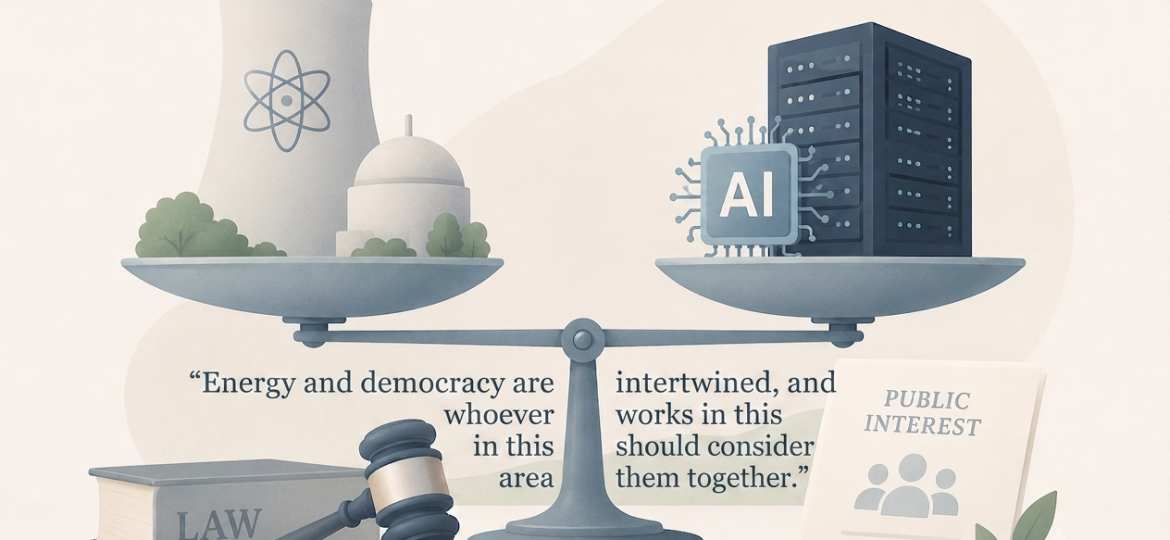
To conclude, I started this opinion by noting that there are two bottlenecks to the adoption of AI at scale – energy and democracy. Also, this post was mainly dedicated to the question of nuclear energy to feed AI, it appears that energy and democracy are intertwined and, whoever works in this area, should consider them together.
References
¹https://thebulletin.org/2025/07/the-first-us-atomic-rush-was-a-bust-will-trumps-big-nuclear-for-ai-plans-fare-any-better/
² https://www.statista.com/statistics/1421067/electricity-capacity-germany/
³https://www.deloitte.com/us/en/insights/industry/power-and-utilities/nuclear-energy-powering-data-centers.html
⁴https://www.power-eng.com/nuclear/aws-acquires-data-center-campus-connected-to-susquehanna-nuclear-station/
⁵ SMRs are generally defined as having electric generating capacity of 300 megawatts (MWe) or less, in contrast to existing nuclear power reactors, which typically exceed 1,000 MWe.
⁶ SCHNEIDER, M., FROGGATT, A., “The World Nuclear Industry Status Report 2019”, (2021) 203–209.
⁷ NEA, “The NEA Small Modular Reactor Dashboard: Third Edition”, NEA No. 7737, Nuclear Energy Agency, OECD, 22 July 2025
⁸ Mycle Schneider and others, The World Nuclear Industry Status Report 2025 (Mycle Schneider Consulting 2025)
⁹ Robert J Duffy, Nuclear Politics in America: A History and Theory of Government Regulation (University Press of Kansas 1997)
¹⁰ Idem