Artificial intelligence is no longer limited to digital interfaces or static datasets. The emerging paradigm is one where intelligence must operate in the real world, interacting with physical systems, environments, and constraints. NVIDIA describes this shift as the rise of physical AI, a concept that is rapidly becoming central to robotics, manufacturing, autonomous systems, and industrial transformation. At the heart of this evolution lies the NVIDIA Omniverse platform, which enables organizations to build and operate high fidelity digital twins that bridge the gap between the virtual and physical worlds.
The convergence of Omniverse, physical AI, and digital twins represents a foundational shift in how industries design, simulate, and optimize real world systems. What was once a fragmented process of design, testing, and deployment is now becoming a unified simulation driven workflow.
What is Physical AI and Why It Matters
Physical AI refers to systems that can “perceive”, reason, and act within real world environments. These systems include autonomous robots, vehicles, and industrial machines that must operate under dynamic and unpredictable conditions. According to NVIDIA’s own research and developer frameworks, physical AI spans the entire lifecycle of robotics and autonomy, from high fidelity simulation and synthetic data generation to deployment and real time decision making in physical environments [1].
Unlike traditional AI models that rely on pre-collected datasets, physical AI must continuously adapt to environmental changes. This makes development significantly more complex. Training models purely in real world environments is costly, time consuming, and often unsafe. As a result, simulation has become a prerequisite for scaling physical AI systems effectively.
NVIDIA Omniverse: The Simulation Backbone
NVIDIA Omniverse serves as a comprehensive platform for building simulation first AI applications. It is a collection of GPU-accelerated libraries, APIs, and microservices designed specifically to develop physical AI and digital twin workflows. By bringing together technologies such as RTX based rendering, PhysX physics simulation, and OpenUSD interoperability, Omniverse enables physically accurate and photorealistic environments where systems can be tested and validated.
What differentiates Omniverse is its ability to unify diverse tools, datasets, and engineering workflows into a single collaborative environment. It allows engineers, developers, and designers to work simultaneously on complex systems, integrating CAD models, sensor data, and simulation logic into one shared virtual space. This integration significantly reduces the friction traditionally associated with industrial system development.
Digital Twins as the Foundation of Physical AI
Digital twins are the core building blocks that make physical AI practical at scale. A digital twin is not just a 3D model but a dynamic and continuously updated virtual representation of a physical system. It incorporates real time data, simulation models, and operational logic to replicate how a system behaves in the real world.
Within Omniverse, digital twins enable organizations to design, simulate, and optimize entire systems before they are physically built. These twins allow for comprehensive scenario testing, predictive analysis, and performance optimization. As highlighted in enterprise implementations, digital twins integrate multiple data sources and simulation layers to create accurate replicas of real-world processes, which can then be used for training AI models and optimizing operations [2].
This makes digital twins not just visualization tools but active environments where intelligence can be developed and validated.
Closing the Simulation to Real Gap
One of the longstanding challenges in robotics and autonomous systems is the gap between simulated environments and real-world performance. NVIDIA addresses this through platforms like Isaac Sim, which is built on Omniverse and designed specifically for robotics simulation. Isaac Sim enables developers to simulate robots in physically accurate virtual environments, complete with realistic sensors such as cameras and LiDAR.
The ability to generate synthetic data, simulate edge cases, and train AI models across thousands of virtual scenarios significantly improves real world performance. Recent research shows that robots trained entirely in simulated environments are increasingly capable of performing reliably in real world conditions, demonstrating meaningful progress in narrowing the simulation to reality gap [3].
Industrial Applications and Real-World Impact
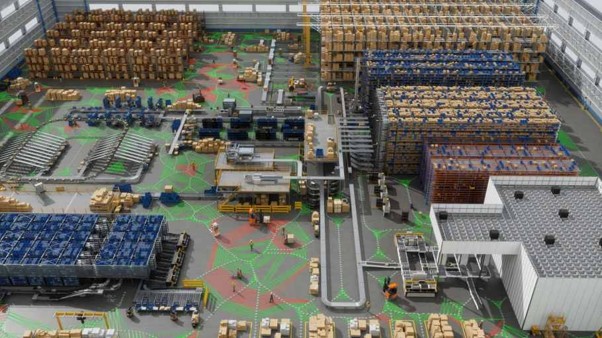
The practical impact of Omniverse and digital twins is already visible across industries. In manufacturing, companies such as BMW are using Omniverse to create full scale digital twins of their production facilities. These virtual factories allow engineers to simulate layouts, optimize robotics workflows, and test production processes years before physical deployment.
For instance, BMW’s virtual factory initiative enables real time simulation of production lines, logistics systems, and human workflows, reducing planning time and costs significantly. In some cases, processes that previously took weeks can now be simulated in days, with projected cost reductions of up to 30 percent in production planning [4].
Beyond manufacturing, similar approaches are being applied to data centre design, robotics training, and infrastructure planning. Digital twins are enabling organizations to simulate entire systems, identify inefficiencies, and make informed decisions before committing to physical execution.
The Role of OpenUSD in Scaling Digital Twins
A key enabler behind Omniverse is OpenUSD, an open standard for describing and composing complex 3D environments originally developed by Pixar Animation Studios. This acts as a common language that allows different tools, datasets, and systems to interoperate seamlessly. It enables teams to build large scale digital twins by integrating assets from multiple sources while maintaining consistency and real time collaboration.
The importance of OpenUSD lies in its ability to scale. Digital twins of factories, cities, and infrastructure systems are inherently complex, involving thousands of interconnected components. OpenUSD provides the composability and flexibility required to manage this complexity while enabling continuous updates and collaboration across teams [5].
Future Outlook: Toward Autonomous Physical Systems
The convergence of physical AI, Omniverse, and digital twins points toward a future where systems are designed, tested, and optimized entirely in virtual environments before being deployed in the real world. This simulation first approach reduces uncertainty, accelerates innovation, and enables a new level of operational intelligence.
As industries adopt these technologies at scale, factories will evolve into self-optimizing systems, robots will gain greater autonomy, and infrastructure will become increasingly intelligent. NVIDIA’s positioning of Omniverse as an operating layer for physical AI reflects this broader vision of an interconnected, simulation driven industrial ecosystem [6].
Conclusion
NVIDIA Omniverse represents a fundamental shift in how physical systems are designed and operated. By combining high fidelity simulation, digital twins, and AI driven workflows, it provides a unified platform for developing physical intelligence at scale. Digital twins act as the bridge between data and reality, allowing organizations to experiment, optimize, and innovate in ways that were previously not possible.
As the boundaries between the physical and digital worlds continue to blur, platforms like Omniverse will play a central role in shaping the future of intelligent industries.
References
[1] NVIDIA Developer Blog — “Physical AI and Open Models for Robots and Autonomous Systems.” This article explains NVIDIA’s concept of physical AI, covering its lifecycle from high fidelity simulation and synthetic data generation to real world deployment in robotics and autonomous systems. https://blogs.nvidia.com/blog/physical-ai-open-models-robot-autonomous-systems-omniverse/
[2] NTT Data Innovation Center — “Utilizing NVIDIA Omniverse for Digital Twin Projects at the NTT Data Innovation Center.” This source highlights enterprise applications of digital twins, demonstrating how simulation, real time data, and AI driven optimization are integrated for industrial use cases. https://www.nttdata.com/global/en/insights/focus/2023/utilizing-nvidia-omniverse-for-digital-twin-projects-at-the-ntt-data-innovation-center
[3] Interesting Engineering — “NVIDIA Robots Trained in Simulation Perform in the Real World.” This article discusses recent advancements in robotics where systems trained entirely in simulation can successfully transfer learning to real world environments, helping bridge the sim to real gap. https://interestingengineering.com/ai-robotics/nvidia-robots-simulation-real-world-icra
[4] BMW Group — “BMW Group Scales Virtual Factory Using NVIDIA Omniverse.” Official press release detailing how BMW leverages Omniverse based digital twins to simulate production systems, optimize planning, and significantly reduce time and cost in factory design. https://www.press.bmwgroup.com/global/article/detail/T0450699EN/bmw-group-scales-virtual-factory
[5] NVIDIA Documentation — “OpenUSD Basics for Digital Twins.” This documentation explains the role of OpenUSD as a foundational standard enabling interoperability, scalability, and real time collaboration across complex digital twin ecosystems. https://docs.nvidia.com/learning/physical-ai/assembling-digital-twins/latest/getting-started/openusd-basics.html
[6] Maginative — “How NVIDIA is Building the Operating System for Physical AI.” This analysis explores NVIDIA’s broader vision of Omniverse as a foundational platform powering physical AI systems and simulation driven industrial transformation. https://www.maginative.com/article/how-nvidia-is-building-the-operating-system-for-physical-ai/