By: Samrat Banerjee and Meriem Kilani
1. The Illusion of a Binary World
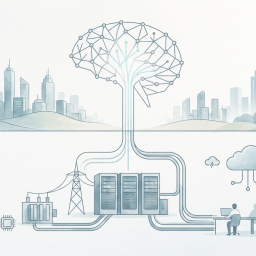
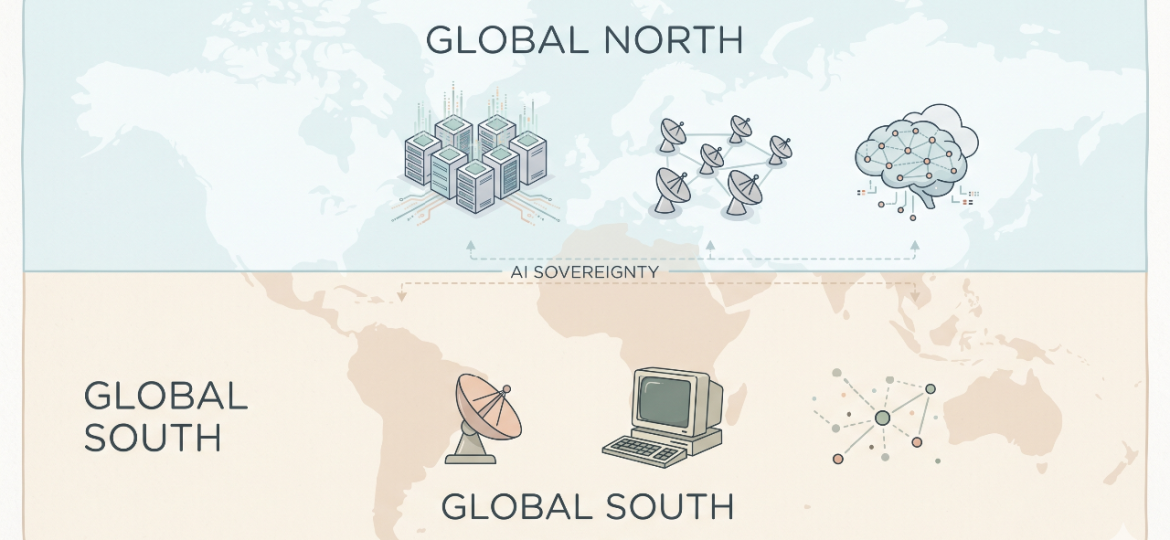
Global North and Global South are just fancy terms for haves and have-nots. Artificial Intelligence is portrayed as the beacon of hope for humanity, but what is the majority of humanity actually doing with it? Helping themselves get rid of mundane tasks at work, drafting emails, summarising documents, fixing spreadsheets. That snapshot is real, but it hides a more uneven landscape. The divide is not only economic. It runs through institutional capacity (who can govern AI), infrastructure (compute, cloud, connectivity), and talent ecosystems (who trains and retains the people who actually build it). Call it the AI map: a layered geography of who can do what.
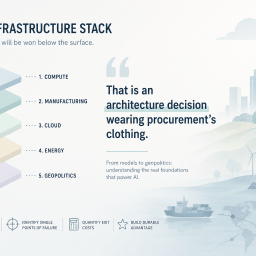
Data, applications, models, and infrastructure are the layers every country has to think about. But no country can own all of them without the help of others. Sovereign AI is not an all-or-nothing pursuit. The smarter question is how we position it: where do we specialise on the value chain? The USA dominates foundational models. India is the world’s services and deployment layer. Israel runs niche innovation. China is building a parallel system. Most other countries will consume and adapt, and that is okay, we should not make them feel guilty about it, provided they keep agency over what matters to them, like data governance and local applications.
Take Europe, the supposed face of the Global North. Europe is sometimes perceived as lagging behind the United States and China in the development of large-scale AI systems, while increasingly positioning itself around regulation and governance. At the same time, the EU AI Act should not be viewed only as a defensive instrument. It is Europe’s pitch to be the world’s trust layer, the way GDPR became a global default. Whether regulation is a competitive advantage or a slow lane is still an open question on which the world will most probably never come to a common understanding. The USA, meanwhile, has the enviable ecosystem of Big Tech, venture capital, universities, deployment muscle, and a military industrial complex now embedding AI in weapons. But “winning” is more complicated than it looks. China is closing the gap on foundational research. The world is becoming multipolar, and that is the honest reality.
2. A Multipolar World, Unevenly Ready
China gave the world a jolt with its DeepSeek moment, and we should assume it is doing more than necessary to catch the US. But “catching up” again might be an incorrect approach. China is building a parallel AI stack which is pretty clear in its approach being state-coordinated, dataset-rich, quick-deployment. The future may throw up not just one clear winner; it could be two ecosystems, and a long tail of countries trying to figure out where they fit.
Russia is opaque. Japan and Korea are wrestling with their demography first. Africa is not one place; it is fifty-four. Kenya and Nigeria are running real fintech experiments with AI. Rwanda is piloting low-cost diagnostics. The honest reality is uneven readiness, not abject unpreparedness.
India may become one of the most influential AI actors within the Global South, although it remains one among several emerging players. Brazil, Indonesia, and the UAE are all building AI capacity in their own ways. Still, India nevertheless possesses a relatively advanced digital public infrastructure ecosystem, from foundational identity and payments with Aadhaar and UPI to credit and commerce with OCEN and ONDC, and a talent pool that already powers a meaningful share of the world’s enterprise software. As India’s Minister for Electronics and Information Technology, Ashwini Vaishnaw, stated during discussions at Davos, the country increasingly frames its AI ambitions across multiple technological layers.[1] At the recent AI Summit, India dragged the global conversation past safety into impact. That shift matters. Northern debates centre on regulation and risk. The Global South’s debate is about jobs, healthcare, food, and dignity of life. Both are valid, but they pull in completely different directions, and whoever sets the agenda decides where capital goes.
Ambition still runs into execution. India has infrastructure gaps, uneven access to digital tools, and real questions about whether a services-led economy can absorb what comes next. Sovereign AI is therefore not merely a political slogan, but a long-term and resource-intensive ecosystem-building process. The Global South’s demographic advantage may also become a structural vulnerability, the demographic that most needs AI to deliver on development goals, and the one most exposed if it doesn’t. AI will not eliminate all jobs, but it will thin out the entry rungs of the white-collar ladder, the very rungs young people are trying to climb.
3. Dependency, Agency, and What We Do Next
The risk of an AI-sharpened divide between the elite of the Global North and everyone else is not just hyperbole or paranoia. The large-scale deployment of advanced LLM ecosystems could increase technological dependency on a small number of dominant AI powers, particularly the United States and China. AI rubbing salt on wounds is a real possibility.
But none of this is inevitable. Dependency and agency can coexist. Foreign platforms dominate today, yet platforms can be built on. India built UPI on top of someone else’s Android and Apple smartphones. Kenya built M-Pesa on someone else’s networks. Local innovation happens inside global systems, not outside them.
The same nuance applies to work. The evidence so far suggests AI automates tasks, not whole jobs. The real danger is fewer entry-level roles and slow reskilling, which is a policy failure, not a destiny. Do we have enough agency to change this? And the deeper question is what we ask AI to do. Healthcare, food security, employment: these are problems we should have solved by now. AI is already showing it can help in some ways. Yield prediction is reaching smallholder farms. Diagnostic AI is arriving in clinics that never had a radiologist. Voice-first AI is letting people transact in languages the internet ignored for two decades. None of this is automatic. It needs institutional governance, public investment, and a deployment imagination that does not just copy Silicon Valley but makes it better according to the needs of different regions.
So the question is not whether humanity survives AI, the way it has survived steam, electricity, and the internet. It will. Humans are adaptable and always find ways to survive in the darkest scenarios. The question is who coordinates the next decade, and on whose terms, basically who calls the shots. The fate of AI in the Global South will be decided less by the technology than by the people governing its rollout. If India seeks to position itself as a long-term technological and geopolitical actor, it will likely need to invest not only in domestic AI capacity, but also in regional and Global South partnerships. Not as the only hope, but as one node that refuses to outsource its future. Historical experiences of dependency continue to shape how many countries approach technological sovereignty today.
References
[1] Ashwini Vaishnaw, remarks on India’s AI strategy during the World Economic Forum Annual Meeting, Davos, 2025.
European Union, EU Artificial Intelligence Act, 2024