AI Is Everywhere , But Value Is hard to find
We are in 2026 and Artificial Intelligence has rapidly shifted from experimentation phase and masses hype to strategic priority and becoming an acquired pillar. Organizations of all sizes are pouring money, running pilots and making AI a central part of their future performance. Expectations are unsurprisingly high, from efficiency gains to new business models. However, under a larger loop, another reality comes to light: Several AI initiatives struggle to get past the early stages. Some get stuck in pilot phases, others don’t scale, and in multiple cases the expected value just doesn’t come to surface. And this is not an isolated case. Several studies and reports have pointed out the real gap between ambition and execution when it comes to AI adoption. [1]
The problem organizations face is not a failure of AI itself, but a couple of deeper, structural and systemic constraints. These are often fuzzy and part of the architecture and functioning of the organization. Let’s call them AI frictions or “Bugs”. These frictions are organizational and fundamental barriers that prevent an organization from realizing the full value of AI initiatives. To better understand where they come from, it’s beneficial to step back and look at the organization through a structured lens.
Analyzing AI Through the Lens of Enterprise Architecture
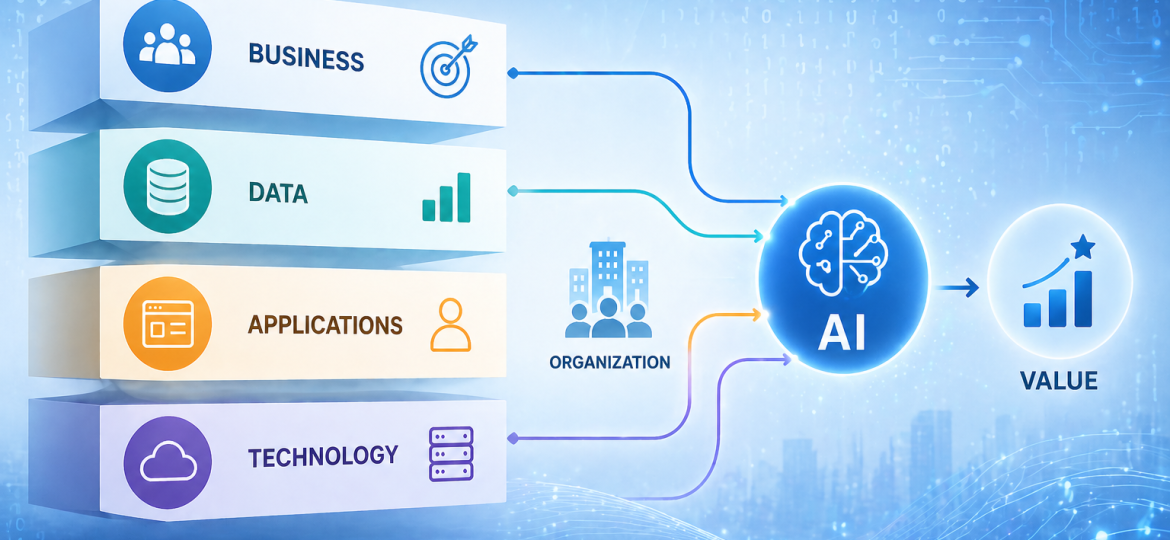
An interesting approach to this challenge is Enterprise Architecture, in particular as structured in frameworks such as TOGAF. From this angle, an organization is not a single system or one monolithic block but is composed of interdependent layers that function in alignment:
- Business Architecture (strategy, organization, processes)
- Data Architecture (data structures, governance, data quality)
- Application Architecture (system and interface and work flow
- Technology Architecture (infrastructure, platforms, scalability)
All these four layers contain AI initiatives. They are data dependent, application deployed, infrastructure dependent and ultimately business value driven.
AI Frictions at the Business Layer: When Strategy Lacks Direction
Lack of ambition is rarely the problem at the corporate level. Businesses are frequently keen to advance AI.
The issue is somewhere else. Sometimes at the highest level, AI is perceived as a priority, but there is no clear direction. Use cases come from many departments inside the organization, often on their own. Some derive from technical teams or outside vendors, while others come from business teams. They are not always related, even though each can make sense on its own. This eventually causes fragmentation. Teams advance, although not always in the same direction. It gets more difficult to describe what AI is truly bringing to the company.
The complexity is increased by ownership. AI projects usually cover many departments, including business divisions, data, and IT. Scaling something that works can be difficult because it is unclear who owns it. When it doesn’t, accountability may be as ambiguous.
This is not uncommon. For instance, banks have made significant investments in AI for consumer analytics or fraud detection, frequently through several concurrent projects. Some provide value locally, but they are nonetheless challenging to scale without a common strategy. Similar trends can be seen in retail, where AI is employed for personalization or forecasting but frequently remains in the pilot stage when it is not in line with more general priorities.
The structure of the projects is what matters, not how many there are. Successful organizations typically concentrate on a small number of high-value use cases, match them with business priorities, and guarantee clear ownership from the outset [1].
In actuality, this entails making decisions. Instead of introducing everything at once, identify the areas where AI is most important and concentrate your efforts there.
AI Frictions at the Data Layer: When Data Cannot Be Reliably Used
If issues at the business level are easy to detect, data ones tend to be more discreet. They sit in the background, but can slow things down just as much.
Most organizations know AI depends on data. What becomes clear over time is how often data itself turns into the main constraint.
In many organizations, data has grown over time rather than being designed as a coherent system. It sits across multiple tools, follows different definitions, and reflects processes that were never built for AI. What looks usable at first often becomes more complex once teams start working with it.
This creates a gap. Models can be developed with promising results in controlled settings, but become less stable when applied to real data. Outputs may vary or require constant adjustments. At that point, the issue is no longer the model, but the environment around it.
This pattern appears across sectors. In healthcare, AI models can perform well during development, but differences in how data is recorded across institutions make deployment more difficult. In industrial settings, predictive maintenance models rely on data from multiple sources, and inconsistencies in collection or integration can limit their reliability.
Research points in the same direction. MIT Sloan highlights data readiness as a key barrier to scaling AI, while Gartner identifies data quality and governance as frequent causes of underperformance. Davenport’s work also shows that organizations treating data as a managed asset are far more likely to succeed [2][3][4].
What makes the difference is not only technology, but how data is handled over time. Organizations that move forward tend to structure it better, clarify ownership, and align on shared standards.
Without that foundation, even strong models struggle to deliver consistent value.
AI Frictions at the Application Layer: When AI Struggles to Find Its Place
Another issue usually arises later in the process, even in cases where data is accessible and models function effectively. It’s not necessarily about the technology per se, but rather how it works with regular tasks.
AI solutions are frequently created in conjunction with current systems rather than inside of them. Even though they are well-designed and easily available, they are nonetheless unrelated to how individuals operate. Workflows remain the same, interfaces feel strange, and users are expected to adjust.
A gap develops over time. Although the tool is present, it does not organically fit into the daily routine.
Sometimes trust is the problem. Users can be reluctant to depend on outcomes they don’t completely comprehend. In other situations, it’s just sensible. The instrument is often disregarded if it requires additional steps or does not fit into current procedures.
This is seen in all sectors. AI assistants are introduced to customer care representatives, however when they are not properly integrated, agents frequently stick to their traditional techniques. If AI insights brought to CRM systems do not align with daily routines, they may remain underutilized in sales.
These scenarios are similar in that there is a gap between the instrument and its context of usage rather than a lack of capabilities.
Research reflects this consistently. MIT Sloan shows that adoption depends as much on usability and integration as on performance, while Gartner highlights that many AI initiatives fail because they are not embedded into business processes in a way that feels intuitive [5][6].
Organizations that move forward tend to design AI as part of the workflow, involve users earlier, and focus on how the tool is actually used.
Even small modifications can make a real difference.
AI Frictions at the Technology Layer: When Systems Struggle to Scale
At the technology level, building models is rarely the main issue. Teams are often able to develop prototypes that work well in controlled environments. The difficulty appears later, when these models need to be deployed and maintained over time.
What works in a test setting does not always translate easily into production. Infrastructure may not be fully ready, systems can be difficult to connect, and deployment processes often take longer than expected. These constraints limit what can realistically be scaled.
Many organizations encounter this once they move beyond experimentation. In industrial settings, predictive maintenance models can perform well in pilots, but integrating them into existing systems and ensuring stable performance at scale is more complex.
In organizations with legacy IT environments, systems were not designed for the flexibility required by AI, so initiatives often remain limited in scope.
Research reflects this gap. McKinsey shows that many AI initiatives do not move beyond pilots due to infrastructure challenges, while Google Research highlights how technical debt affects long-term performance [7][8].
Beyond the Model: Where Alignment Really Matters
Looking at each layer separately helps, but most difficulties appear when they do not connect properly. A strong model cannot compensate for weak data, just as a clear strategy brings little value if tools are not used. AI challenges are less about technology than about coordination across the organization. This is where governance becomes essential, not only for compliance, but to clarify priorities, ownership, and decision-making. Organizations that move forward tend to make these elements explicit and define how risks are managed [6].
At the same time, the human dimension remains central. AI changes how people work and make decisions, which naturally creates hesitation. Adoption depends as much on trust and involvement as on performance, something change management research has long emphasized [7]. In the end, AI is less something to deploy than something to integrate. What makes the difference is the ability to align strategy, systems, and people.
References
[1] McKinsey Global Institute, The State of AI Report, 2023
[2] MIT Sloan Management Review, Artificial Intelligence and Business Strategy, 2018
[3] Gartner, AI Adoption and Data Quality Reports, various publications
[4] Davenport, T. H., Competing on Analytics: The New Science of Winning, Harvard Business Review Press
[5] MIT Sloan Management Review, AI, Automation, and the Future of Work, 2020
[6] Gartner, AI Governance and Organizational Readiness Reports, various publications
[7] McKinsey Global Institute, Scaling AI in the Enterprise, insights and reports
[8] Sculley, D. et al., Google Research, Hidden Technical Debt in Machine Learning Systems, 2015