Author: Dr. Cristina Teleki, Assistant Professor, European Centre for Privacy and Cybersecurity, Maastricht Unniversity Faculty of Law
Disclaimer: An AI tool has been used to ensure the correct and coherent translation from German of two paragraphs.
A recent report on physical AI highlights that multimodal foundation models are redefining robot intelligence by enabling generalization across tasks and environments. In particular, these advances allow robots to adapt to unfamiliar situations without task specific reprogramming.[1] The report also highlights that the falling costs of key hardware components such as sensors, actuators, and commercial models such as robotics-as-a-service (RaaS) are lowering barriers to adoption. In addition, the report argues that demographic and economic pressures – including aging workforces and persistent labor shortages – are intensifying demand for robotic systems capable of taking on roles that are hard to staff.[2] Finally, record venture capital investment into physical AI and robotics is building the momentum behind these shifts.
Such developments are both interesting and welcomed by industry leaders. They hold many promises, especially in the EU where more autonomy is sought through re-industrialization. Physical AI and robotics though, just like any other emerging technology, also raise many questions. One important question in this regard is the impact of physical AI and robotics on corporate governance. To be sure, corporate governance deals with the systems, rules, and processes by which corporate activity is directed. Both narrow and broad definitions of corporate governance exist. First, the narrow definitions focus on the relationships between corporate managers, a company’s board of directors, and its shareholders. The broader definitions focus on the relationship of the corporation to all of its stakeholders and society.[3]
A few models of corporate governance exist around the world. In the US corporate governance gives preference to shareholder interest. We may call this model of corporate governance “shareholder-driven”. The other models of corporate governance selected for this essay could be called “stakeholder-driven” due to the fact that they focus – in addition to the revenue creation – on the representation and participation of other stakeholders within and outside the corporation. In Germany, for example, labor unions traditionally have had seats on corporate boards. At Japanese firms, loyal managers often finish their careers with a place in the boardroom. Founding families hold sway on Indian corporate boards. And in China, boards are populated by Communist Party officials.[4] The question that this essay explores concerns the consequences for various corporate governance models of work force being replaced with physical AI and robotics.
In Germany, for example, corporate law defines the role of the board to govern the corporation for the “good of the enterprise, its multiple stakeholders, and society at large.”[5] Large public German companies organised as Aktiengesellschaften (AGs) are required to have a two-tier board structure: a supervisory board (Aufsichtsrat) responsible for oversight, and a management board (Vorstand) responsible for operations. The supervisory board appoints and oversees the management board. The management board consists almost entirely of the senior executives of the company, meaning management board members have considerable firm- and industry-specific knowledge.
The degree of employee representation on the supervisory board – or the so-called codetermination – depends on company size. For companies with more than 500 employees, the Drittelbeteiligungsgesetz provides that one-third of the supervisory board must be elected by workers.[6] For companies with more than 2,000 employees, the Mitbestimmungsgesetz requires that half of the supervisory board consist of worker representatives.
The reason for this two-tiered board structure is the explicit representation of stakeholder interests beyond those of shareholders alone. Thus, depending on company size, employee representation ranges from one-third to one-half of supervisory board members and ensures that no major strategic decisions can be made without some degree of cooperation from employees and their representatives.
Coming back to the main question of this essay, it appears that from the corporate governance models briefly enumerated above, the shareholder-driven corporate governance model will likely see the least impact on its corporate governance. Since the shareholder-driven model is mainly concerned with shareholder interest, the adoption of physical AI and robotics at scale might diminish labor costs, while also increasing shareholder revenue.
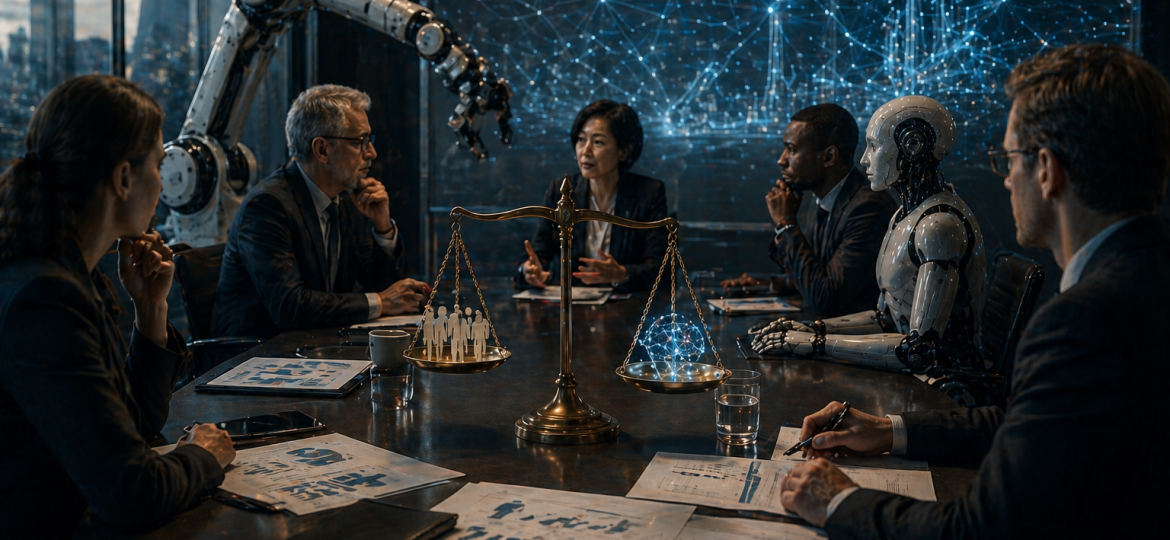
The stakeholder-driven corporate governance models though might experience important impacts from the wide adoption of physical AI and robotics. On the one hand, the advisory board structure will be directly impacted by a smaller workforce. On the other hand, the interests of physical AI and robotics could be represented on corporate boards in addition to the interests of the human labor force. Finally, beyond the corporation, physical AI and robotics will certainly impact other stakeholders relevant for all corporations, such as the tax authorities, auditing authorities, banks etc.
To conclude, the wide adoption of physical AI and robotics will likely affect all corporate governance models. The most drastic changes are likely to be felt in the stakeholder-driven model. Corporate governance rules should thus be updated to allow for harmonious frameworks of work and governance to emerge and to be executed.
[1] Capgemini Research Institute, Physical AI: Taking Human-Robot Collaboration to the Next Level (Capgemini Research Institute 2026) <https://www.capgemini.com//srv/htdocs/wp-content/uploads/2026/04/Final-Web-Version-Report-Physical-AI.pdf\>accessed 28 April 2026.
[2] Idem.
[3] Brian R Cheffins, Advanced Introduction to Corporate Governance Law and Regulation (Edward Elgar Publishing 2024) <https://doi.org/10.4337/9781035315734\> accessed 28 April 2026.
[4] Bradley, Michael and Schipani, Cindy A. and Sundaram, Anant K. and Walsh, James P., The Purposes and Accountability of the Corporation in Contemporary Society: Corporate Governance at a Crossroads. Law and Contemporary Problems, Vol. 62, No. 3, Summer 1999, Available at SSRN: https://ssrn.com/abstract=220570 or http://dx.doi.org/10.2139/ssrn.220570
[5] Aktiengesetz (AktG) of 6 September 1965 (BGBl I p 1089), as amended by Act of 23 October 2024 (BGBl I no 323), s 1 (Ger
[6] One-Third Participation Act (Drittelbeteiligungsgesetz – DrittelbG) of 18 May 2004 (BGBl I p 974).