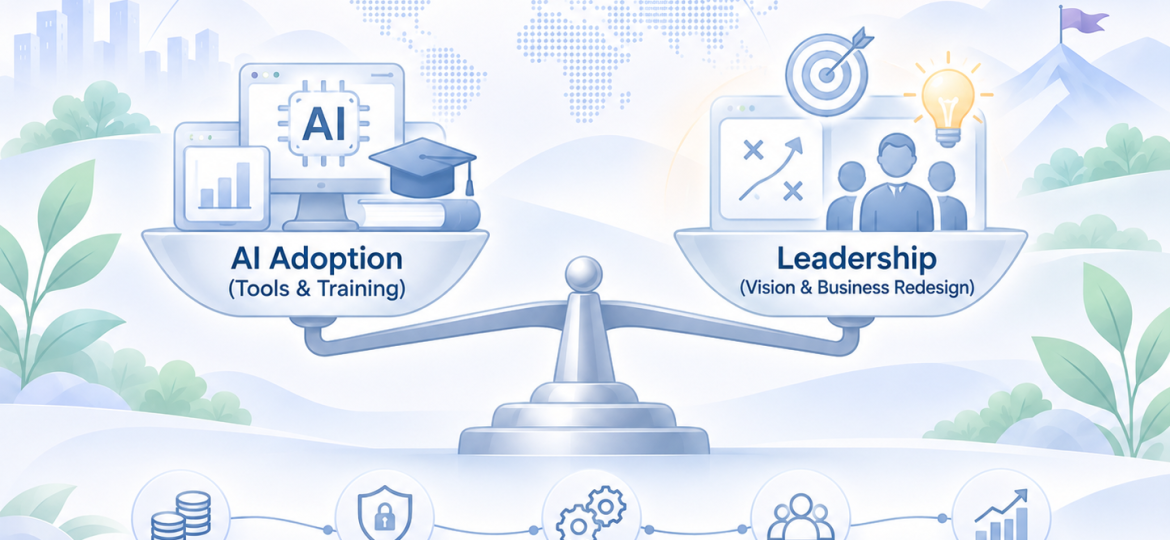
We are investing heavily in AI adoption. Employees are learning how to write prompts, summarise documents, generate presentations and automate everyday tasks… and that’s a good thing.
But as we are teaching people how to use AI, or are we also teaching them how to rethink the way we work? Despite the fundamental difference, much of the conversation around AI adoption continues to focus on the former 1 2
We measure training completion, tool usage and time saved. But these metrics don’t necessarily tell us whether we are fundamentally changing how our organisations operate. And this is where I believe a significant skills gap is emerging and that is actually among leaders and not employees.
Are We Repeating the PC Revolution of the 1990s?
Think back to the 1990s, when businesses invested heavily in personal computers.
The logic was relatively straightforward: equip employees with computers, provide software and expect productivity to improve.
The investment was tangible. Computers had purchase prices, expected lifespans and reasonably predictable replacement costs. Although software, infrastructure and support added expenses, the initial capital investment was relatively easy to estimate.
Today, AI adoption can appear similarly straightforward.
Give employees access to AI tools, provide training and let productivity gains follow.
But there’s a fundamental difference.
AI isn’t simply another piece of technology we purchase. It’s a capability we consume, integrate and continuously evolve.
When AI Adoption Moves Faster Than Understanding
While some AI tools operate through predictable subscriptions, more advanced solutions can introduce consumption-based costs that grow with usage, computing requirements and the complexity of the tasks being performed.
And those costs can escalate surprisingly quickly.
In June 2026, TechCrunch reported that Uber had exhausted its annual employee AI spending budget within just four months, prompting the company to introduce spending limits 3.
The lesson is not that AI is inherently too expensive.
It’s that AI spending can grow faster than anticipated when adoption outpaces financial visibility and operational controls.
Consider another common mistake: using the most powerful and expensive AI model for every task, regardless of complexity.
Does a routine document classification task require the same model as a sophisticated analytical problem?
Probably not. The most advanced model is not automatically the most appropriate business solution and research demonstrates how selecting models according to task complexity can reduce costs while maintaining performance 4 5 6.
But choosing the right model is only part of the equation.
Even the most cost-efficient AI solution becomes a poor investment if it is solving the wrong business problem and organisations risk paying for intelligence they don’t need while failing to invest in aspects they actually need.
To top it up financial exposure is only one part of the challenge. In 2023, Samsung employees reportedly submitted confidential source code and internal meeting information to ChatGPT while attempting to perform their work tasks more productively. They weren’t trying to compromise their organisation. They were trying to be productive. Samsung subsequently introduced restrictions on the use of generative AI tools 7 but the incident illustrates fundamental security risks employees encouraged to use AI don’t fully yet understand.
The Missing Link Is Leadership
Above examples point to a broader challenge. Is responsible AI adoption simply a matter of introducing usage policies?
As employees understand the inefficiencies of their daily work and technology specialists understand what AI can make possible, who effectively connects those two perspectives?
I believe that responsibility belongs to leaders. Not because leaders should become AI engineers, but because they understand the business well enough to recognise where technology can create meaningful change.
Without sufficient AI literacy, leaders risk making two equally problematic mistakes.
They may overestimate AI’s capabilities, investing in expensive solutions without understanding their limitations, dependencies or total cost or they may underestimate its potential, missing opportunities to fundamentally redesign how their business operates.
Both result from the same problem: making strategic decisions without adequately understanding the technology.
Using Tomorrow’s Technology to Accelerate Yesterday’s Processes
But there is another layer to above mistakes that deserves equal attention.
We often see inadequately prepared leaders declaring AI and digital transformation as strategic priorities. But is that really a strategy if does not explain which business problems need solving, what outcomes matter, which processes must change and how the organisation will measure success?
Consider a process that requires information to pass through multiple departments, several approval stages and disconnected systems.
AI might help prepare the documents, summarise the discussions and accelerate the approvals. AI cannot automatically create collaboration between departments that operate with conflicting objectives, disconnected information and unclear responsibilities.
If the approvals aren’t unnecessary, the underlying data is unreliable and the departments involved are not aligned, what have we really achieved?
Without proper leadership, we may have made a process faster, but not necessarily better. Worse still, we have invested in sophisticated technology to preserve processes that should have been fundamentally redesigned.
The Leadership Gap We Need to Close
We’ve spent considerable effort teaching employees AI skills. But how many hours have we spent preparing leaders to rethink the way their organisations operate in light of AI?
These are the characteristics that will increasingly define an effective AI transformation leader 11.
- A Strategical Catalyst for Change
They challenge established processes rather than simply looking for ways to accelerate them. They ask: If we were designing this process today, knowing what AI can do, would we still do it this way?
- AI-Literate, Not Necessarily Technical
They understand AI’s capabilities and limitations well enough to recognise opportunities, challenge assumptions and know when AI is appropriate, and when a simpler solution might be better.
- Commercially and Risk Aware
They evaluate AI investments against their full cost, potential value and associated risks. They know that an impressive demonstration doesn’t necessarily make a sustainable business case.
- A Bridge Between Business and Technology
They connect those who understand business challenges with those who understand technological possibilities, aligning expertise and priorities around meaningful outcomes.
We don’t need every leader to become an AI engineer. But we do need leaders who understand AI well enough to make strategic decisions, recognise transformation opportunities and lead meaningful change.
The real AI skills gap may not be where we’ve been looking.
AI adoption can start with employees but business transformation must be led.
References
- McKinsey & Company. (2025). The State of AI: How Organizations Are Rewiring to Capture Value. McKinsey: The State of AI
- Microsoft & LinkedIn. (2024). 2024 Work Trend Index Annual Report: AI at Work Is Here. Now Comes the Hard Part. Microsoft Work Trend Index 2024
- TechCrunch. (June 2, 2026). Uber caps employee AI spending after blowing through budget in four months. TechCrunch: Uber’s AI spending limits
- TMLS. Model Routing & Cascades. TMLS: Model Routing & Cascades
- Chen, L., Zaharia, M., & Zou, J. (2023). FrugalGPT: How to Use Large Language Models While Reducing Cost and Improving Performance. arXiv. FrugalGPT
- Ong, I., et al. (2024). RouteLLM: Learning to Route LLMs from Preference Data. arXiv. RouteLLM
- Reuters. (May 2, 2023). Samsung bans use of generative AI tools like ChatGPT after April internal data leak. Locate Reuters reporting
- National Institute of Standards and Technology. (2023). Artificial Intelligence Risk Management Framework (AI RMF 1.0). NIST AI 100-1. NIST AI Risk Management Framework
- World Economic Forum. (2025). The Future of Jobs Report 2025. World Economic Forum
- Brynjolfsson, E., Li, D., & Raymond, L. R. (2023). Generative AI at Work. National Bureau of Economic Research, Working Paper No. 31161. Generative AI at Work
- Microsoft Learn. Microsoft Certified: AI Transformation Leader. Microsoft Credentials and Certifications