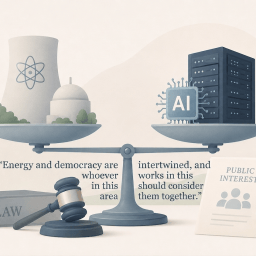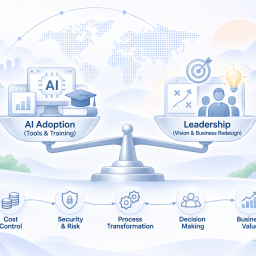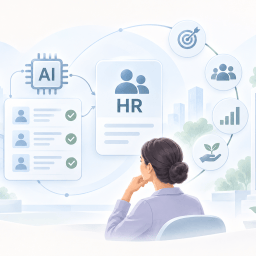

As artificial intelligence makes answers abundant, the human advantage may lie in framing better problems, connecting unfamiliar ideas and taking responsibility for what we choose to pursue.
By Saikat Kamal
Imagine two graduates entering the workforce in 2030. Both can analyse data, write code, prepare convincing presentations and use artificial intelligence to solve complex problems. One has spent years becoming exceptionally good at completing assigned tasks. The other has developed a different habit: questioning the assignment itself.
The first graduate completes the brief with impressive efficiency. The second asks whether the brief addresses the real problem. That question may prove more valuable than another hour saved.
For generations, education and employment rewarded the ability to acquire knowledge, process information and produce correct answers. Those capabilities still matter, yet AI is rapidly changing their economics. Tasks that once demanded substantial time and specialist effort can now be performed with the help of widely available systems.
This raises a question that goes beyond whether AI will replace particular jobs: when intelligent outputs become abundant, what makes human contributions valuable?
The answer lies not in searching for cognitive tasks that machines will never perform, but in understanding how the value of human capabilities shifts when machines perform more of them. As analysis and production become cheaper, value can shift toward framing meaningful problems, evaluating competing possibilities, connecting knowledge across disciplines and accepting responsibility for consequential decisions.
The danger is not only that machines will learn to work like us. It is that we will continue to define our value by how well we work like machines.
The great repricing of intelligence
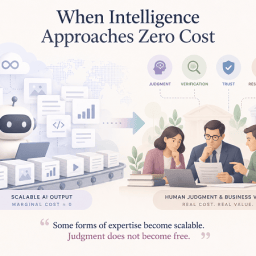
Behind the excitement surrounding AI lies an enormous industrial undertaking involving semiconductors, data centres, cloud infrastructure and increasingly capable models. For ordinary professionals, however, the more immediate shift is the falling cost of cognitive work.
According to Stanford University’s 2025 AI Index, the inference cost for a system performing at roughly GPT-3.5 level fell more than 280-fold between November 2022 and October 2024.1That does not mean every form of intelligence is cheap, or that AI systems are reliable in every setting. It shows how quickly capabilities that were once scarce can become widely accessible.
In their book Prediction Machines, economists Ajay Agrawal, Joshua Gans and Avi Goldfarb describe AI as a technology that lowers the cost of prediction.2When prediction becomes cheaper, the othercomponents of decision-making—objectives, judgment and accountability—rise in value. Generative AI extends this shift beyond prediction: it drafts reports, writes software, summarises documents and proposes dozens of solutions in seconds. Reducing the cost of prediction and generation transforms the demands placed on decision-making.
The economic consequences will not be uniform. Greater productivity does not automatically translate into higher wages or more secure work. Whether AI complements workers or substitutes for their tasks will depend on how organisations deploy it, how work is redesigned and how the gains are distributed. That makes the distinction between producing an output and exercising judgment more than a philosophical concern.
Consider an organisation trying to improve a product. AI can analyse customer feedback, identify patterns, estimate costs and propose dozens of redesigns. The organisation suddenly has more analysis and more options than ever before—yet none of those outputs tells leaders which option to choose.
Should the company prioritise cost, safety, accessibility, environmental impact or long-term trust? What happens when those goals collide? Which assumptions sit beneath the model’s analysis, and who bears the consequences if the chosen solution fails?
AI expands the range of available options. It does not remove our responsibility for deciding which options deserve to be pursued.
What a camera cannot decide on its own
My work in automotive camera and image signal processing architecture has shaped how I think about the boundary between technical intelligence and human judgment.
Consider a vehicle approaching a pedestrian crossing on a rainy evening. The camera captures light under poor conditions; image signal processing transforms raw sensor data into usable images; perception algorithms identify pedestrians, vehicles and road markings. Better sensors and models can improve detection, although reliability still depends on conditions and validation.
Yet detection is only one part of the system. Suppose a child is standing near the edge of the crossing, partly obscured by a parked van. A perception model detects the child with a given level of confidence. A prediction model estimates possible trajectories, including the likelihood that the child will step into the road. Neither output tells the vehicle how to act.
That response depends on safety objectives and decision rules governing uncertainty, severity of harm and competing risks. In engineering practice, we face concrete trade-offs: responding aggressively to uncertain detections may reduce the chance of missing a pedestrian, but unnecessary braking can create risks for following traffic. Deciding how much uncertainty is tolerable, how a vehicle behaves when visibility deteriorates and what safety margins apply when predictions are unreliable are engineering and ethical choices—shaped by validation standards, regulation and the accountability of specialists. Predicting that a child is unlikely to step forward is not the same as deciding that the remaining risk is acceptable.
The same distinction is becoming visible well beyond automotive engineering. In February 2026, Anthropic CEO Dario Amodei defended restrictions on using Claude for fully autonomous weapons and mass domestic surveillance3, while supporting other national-security applications. His position drew a distinction between assisting consequential decisions and delegating them to systems whose reliability and governance remain contested. The example is not equivalent to road safety, but it exposes a similar question about the limits of autonomy.
Whether a vehicle detects a pedestrian or a defence system flags a potential threat, the underlying principle holds: technical capability does not answer what we should allow a machine to do autonomously, under which conditions or who remains accountable when it fails. Those decisions begin long before an algorithm produces an output—they begin with how we define the problem.
Climb higher than the answer
Modern education and workplace training are largely built around solving problems someone else has already defined. Students receive questions and are graded on correct answers; employees receive targets and are evaluated on execution; engineers receive specifications and work to meet them.
Complex organisations need that structure to function. Yet an exclusive focus on execution creates a blind spot: people grow skilled at solving assigned problems without asking whether they are solving the right ones.
When machines rapidly generate plausible answers to clearly stated prompts, formulating, challenging and refining the question becomes central to human work. This involves three distinct abilities: framing the problem, testing the assumptions behind proposed solutions and evaluating their broader consequences. A well-framed problem can still yield an unreliable answer; a technically accurate answer can serve a flawed objective; and an attractive solution can fail because its wider effects were overlooked.
The revised Bloom’s taxonomy, developed by Lorin Anderson and David Krathwohl, maps cognitive processes from remembering and understanding through applying, analysing, evaluating and creating.4Generative AI can assist with activities across this spectrum. Bloom’s taxonomy is a framework for learning, not evidence of AI capability; the empirical question is what these systems can actually do and with what limitations.
In fact, research by Anil Doshi and Oliver Hauser published in Science Advances found that access to generative AI improved the quality of individual short stories while reducing collective diversity across the stories produced.5That finding captures an emerging tension: AI helps individuals produce stronger outputs, yet widespread reliance on similar models can narrow the collective range of ideas.
Education should therefore reward not just correct answers, but the quality of a student’s questions, the reasoning behind a choice and the willingness to revise assumptions. A student trained only to follow instructions will compete directly with machines built to follow instructions. A student trained to examine the purpose and limits of those instructions can uncover possibilities the original assignment never contained.
Creativity is the expansion of choice
If AI can generate a hundred ideas in seconds, does human creativity lose its value? Only if we confuse creativity with volume.
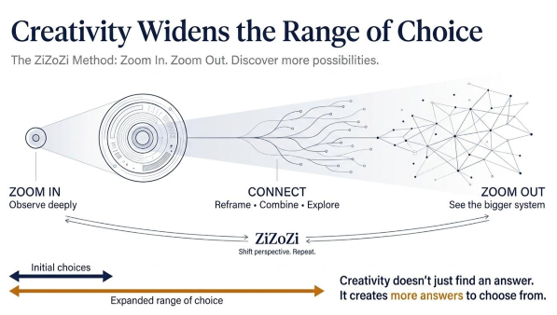
Rather than treating creativity as a mysterious gift reserved for artists, it is more useful to see it as a practical discipline that widens the range of meaningful choices available to us. I approach it through three steps: Zoom In, Connect and Zoom Out. Zooming in means examining a problem closely enough to spot details and constraints others miss. Connecting means combining insights from different fields to reveal hidden relationships. Zooming out means stepping back to ask whether the original problem was framed too narrowly.
Consider a city struggling with traffic congestion. If the brief is simply to move cars faster, AI can optimise traffic signals, model road capacity and propose infrastructure upgrades. Zooming in, however, reveals that bottlenecks cluster around specific school runs, shift changes and transit hubs. Connecting transport engineering with behavioural science and urban planning points toward staggered working hours, better local transit links and incentives for shared travel. Zooming out reframes the question entirely: instead of asking how to move cars faster, how can people reach work, schools and healthcare without spending hours commuting?
That shift changes the objective against which every solution is judged. Here, creativity and judgment reinforce one another: creativity expands and reframes the options, while judgment tests which options are feasible, relevant and worthwhile in the real world. The advantage is not outproducing a machine at brainstorming. It is recognising when a better framing changes what deserves to be solved—and escaping the tyranny of the first sensible answer.
Depth matters. So does range.
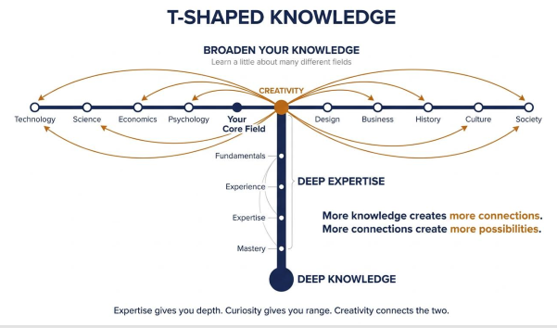
Challenging assumptions and evaluating AI outputs requires real domain knowledge; without it, it is hard to tell an insightful critique from an uninformed objection. An automotive engineer must understand physical and sensor constraints; a clinician needs medical expertise; a lawyer must grasp legal principles. AI makes that deep expertise more important, not less, because someone must verify whether a plausible output is actually sound.
Yet depth alone falls short when a decision’s consequences cross disciplinary boundaries. T-shaped knowledge captures the necessary balance: deep expertise on the vertical axis, paired with the breadth to collaborate across fields on the horizontal axis. An engineer who understands psychology designs more intuitive systems; a clinician fluent in data science interrogates diagnostic tools more effectively; a designer attentive to culture avoids building products that work in one context and fail in another.
This breadth becomes vital as AI crosses national and cultural borders. A model trained in one social environment encounters different languages, infrastructure, norms and expectations around privacy elsewhere. Turning technically possible systems into solutions that work responsibly in the real world requires pairing technical rigour with local knowledge, cultural awareness and the humility to recognise that one’s own perspective is incomplete.
The network is part of the intelligence
There is another capability that rarely appears on a technical benchmark: the ability to build relationships across boundaries.
Many consequential problems cannot be understood or solved by one individual, however knowledgeable.
An engineer may understand technical performance. A safety specialist may identify unacceptable risks. A customer may reveal an overlooked need. A colleague working in another country may recognise an assumption that does not hold locally.
The challenge is not merely collecting these perspectives. It is creating conditions in which they can influence the decision. Organizational charts describe authority, but they do not fully describe how insight travels. An overlooked engineer, an unexpected customer or a colleague from another discipline may hold the missing piece of a problem.
As AI makes individual production faster, the ability to coordinate people, negotiate conflicting goals and build trust may become more consequential.
A valuable professional network is not simply a long contact list. It is a web of trust through which different forms of knowledge can meet, challenge one another and produce better decisions.
I think of professional resilience as the interaction of three forms of capital.
Knowledge capital is what we understand deeply. It provides the expertise required to evaluate information and recognise technical limitations.
Creative capital is our ability to question assumptions, connect unfamiliar ideas and imagine alternative approaches.
Relationship capital is our capacity to learn from others, collaborate across boundaries and bring different perspectives into collective decisions.
These forms of capital do not replace judgment. They provide the foundations on which informed judgment can operate.
Knowledge without imagination may produce increasingly efficient solutions to poorly chosen problems. Creativity without expertise may generate possibilities that cannot withstand scrutiny. Both may fail when decisions ignore the people who must live with their consequences.
Their interaction is what makes them powerful. In an AI-enabled world, professional value may increasingly depend on how effectively we combine these capabilities to make better decisions, rather than simply producing more work.
The future is a choice, not a forecast
None of this guarantees a painless transition. Even if AI raises productivity, workers may not share equally in the gains, particularly when employers use it to substitute for rather than complement their work. Workers cannot adapt through individual creativity alone; schools, employers and governments must widen access to learning, mobility and opportunity.
Nor should we assume humans will keep a permanent monopoly over specific cognitive skills. As AI systems grow better at reasoning and generating alternatives, the boundary between human and machine capabilities will keep moving. What cannot simply be delegated away is the responsibility of people and institutions to decide where oversight is required and who is answerable for outcomes.
Return to the two graduates. Both use AI to analyse a difficult problem and produce a polished recommendation. The first executes the brief quickly and accurately. The second interrogates the objective, tests the underlying assumptions, draws in insights from adjacent fields and weighs the consequences for the people affected. That habit only pays off if organisations reward thoughtful pushback rather than penalising anyone who slows down execution—yet in environments where answers are cheap, catching a flawed premise or an unexamined risk creates value that speed alone never can.
The same principle scales from individual careers to institutions. Companies must decide what they optimise; engineers must define how systems behave under uncertainty; societies must choose which risks are acceptable and whose interests technology serves.
For centuries, machines extended the power of our muscles. Now they are extending the reach of our minds. When answers become abundant, better questions become powerful. When analysis becomes cheap, judgment becomes precious. And when technology multiplies what is possible, our defining responsibility is to choose what is worthwhile. The future will not be shaped solely by how intelligent our machines become, but by how wisely we choose to use them.
Sources
- Stanford HAI, 2025 AI Index: https://hai.stanford.edu/ai-index/2025-ai-index-report
- Agrawal, Gans and Goldfarb, Prediction Machines (2018): https://www.predictionmachines.ai/
- Anthropic, Statement on Department of War discussions (February 2026): https://www.anthropic.com/news/statement-department-of-war
- Anderson and Krathwohl, A Taxonomy for Learning, Teaching, and Assessing (2001): https://www.loc.gov/item/00063423/
- Doshi and Hauser, Science Advances (2024): https://doi.org/10.1126/sciadv.adn5290