Generative engine optimization, or GEO, has become one of the most talked-about ideas in marketing and product circles. At its simplest, GEO is the practice of shaping content so that generative AI systems surface and cite it, rather than optimizing to rank in a traditional list of results.[1] More and more people now put their questions straight to AI systems like ChatGPT and Perplexity, or read Google’s AI Overviews instead of scrolling a list of blue links, and businesses want to know how to show up inside the answer itself. In 2026, Google published official guidance for AI Overviews and AI Mode. The verdict was deflating: optimizing for these Google Search features is, in Google’s own words, “still SEO.”[2] That verdict covers Google’s own Search features, not every AI answer engine.
Google was blunt about it. Its AI features, AI Overviews and AI Mode, are rooted in the same core ranking and quality systems as ordinary Search. The guidance devotes a whole section to what you do not need: no llms.txt files, which it says Google Search does not use; no breaking content into tiny pieces; no AI-specific rewriting; no special structured data.[3] Write for readers rather than for a parser, and good SEO carries over. For an industry that had started selling GEO as a brand-new discipline, the message was almost a shrug. You already know how to do this.
Reading that as “nothing has changed” misses what is actually moving. Traditional SEO competes for a rank and, in the end, a click. Consider someone looking for a lawyer. In the old model they typed “employment lawyer in Seoul” into a search box and worked down the list of results. Increasingly they just ask an assistant, “who is a good employment lawyer in Seoul?” and read the two or three names it gives back. SEO decided who ranked in that list; GEO decides who gets named in that answer. A firm can rank first for the query and still never appear in the sentence the AI says out loud. Visibility is shifting from the ranked link to the citation, from being found to being quoted. That is a different game, even if the work that feeds it looks familiar.
Strip away the marketing vocabulary and the game has a plainer name: retrieval. Google’s own guidance is unusually direct about it. The AI features, it explains, retrieve relevant content from the Search index through retrieval-augmented generation, or RAG, and use it to ground an answer. But retrieval has more moving parts than a single lookup. Google also describes query fan-out: the model expands the original question into a set of concurrent, related searches.[4] An answer may draw on far more retrieved material than it can ever name. Retrieval is where a grounded answer starts, not where citation is settled. A page can be retrieved and never cited, cited and never materially used, or dropped for answer length, source diversity, or platform priorities. GEO is a retrieval problem before it is a marketing one. Anyone who has built a RAG system recognizes the pattern: whether a source is used or quietly ignored turns less on clever wording than on whether the text is retrievable, well scoped, and consistent enough to build on. Read that way, Google’s advice to write for readers rather than parsers is less of a platitude than it sounds.
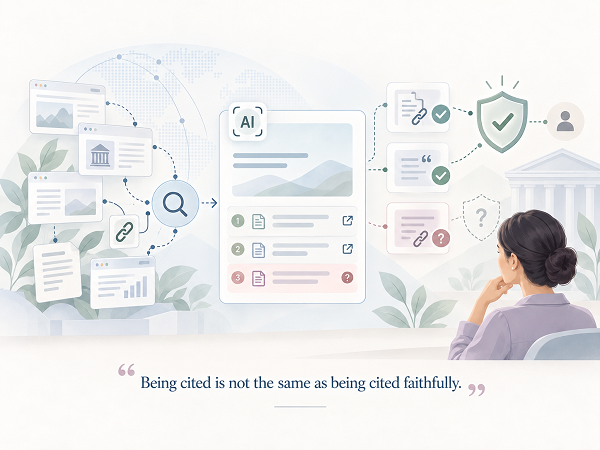
But being cited does not settle whether the citation deserves trust. A model can wrap an authoritative-looking source around a claim the source never made, or point to a page that only looks credible. In 2023, New York lawyer Steven Schwartz encountered an extreme version of the problem in Mata v. Avianca. He used ChatGPT to prepare legal research for a filing that cited six judicial decisions the system had invented, each with a plausible name, citation, and quoted passage. At some point he asked ChatGPT whether the cases were real, and it assured him they were. His accounts to the court never agreed on when he asked: before the filing, or only after the judge started asking questions. They were not real. Judge P. Kevin Castel fined him, the colleague who signed the filing, and their firm $5,000. Castel also ordered them to write to every judge whose name ChatGPT had attached to a fabricated opinion.[5] This was fabricated authority, not a retrieved source being misquoted, but it exposed the same verification gap: a plausible citation can travel farther than its evidence. The grounded version is quieter and more common: the source exists, the page is real, the link resolves, and the sentence above it still says something the page does not. Most users never see the retrieval behind an answer. They see a confident paragraph and maybe a small link. When the citation is wrong, it does not look wrong. It looks plausible, and that is what makes it dangerous.
This is where GEO stops being a marketing question and becomes a question of reliability. As AI answers stand in for the act of searching, the systems that pick and present sources have more say in which claims a reader takes as credible. Getting cited and making sure the citation is faithful are two different jobs, and only the first has a budget behind it. At a minimum, a citation is correct only when the source materially supports the specific claim attached to it, not merely the general topic. In the stricter research sense, citation faithfulness also asks whether the source actually informed the generated claim rather than being appended after the fact.[6] The harder problem is that neither is easy to check from the outside. The question is not whether an answer sounds authoritative, but whether a reader can trace a particular sentence back to what supports it. Reliable claim-level provenance remains an open engineering and evaluation problem. Existing methods can test aspects of citation correctness and faithfulness, but no published approach yet offers a dependable guarantee across systems and domains. That gap matters far more in a medical summary or a legal brief than in a suggestion for what to buy.
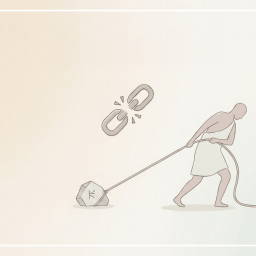
Take Google at its word: for AI Overviews and AI Mode, this really is “still SEO.” For those features, the practical advice is to write genuinely useful, retrievable, trustworthy content, not to trick a parser. But the guidance answers a narrower question than the one that now matters. It tells you how to be seen, not whether to be believed. The question is no longer only how to rank. It is whether a piece of content is something a machine can quote without getting it wrong, and whether anyone would notice if it did. For creators, that means writing to be quoted accurately, not just found. For the platforms doing the quoting, it means treating claim-level support and traceable attribution as product requirements, not research problems. Being the source of an answer is not the same as being a reliable one.
None of this makes GEO a new craft to master. It makes visibility and credibility, once separate concerns, impossible to pursue apart. Being cited and being right remain different problems, but AI answers force publishers and platforms to confront them together. The work worth doing is less about being louder inside the answer and more about becoming a source the answer can safely trust. That is the part no guidance, Google’s included, has solved yet.
[1] Aggarwal, P., Murahari, V., Rajpurohit, T., Kalyan, A., Narasimhan, K. and Deshpande, A. (2024) ‘GEO: Generative Engine Optimization’, KDD 2024, pp. 5-16. Available at: https://doi.org/10.1145/3637528.3671900 (Accessed: 27 September 2026).
[2] Google Search Central (2026) Optimizing your website for generative AI features on Google Search. Available at: https://developers.google.com/search/docs/fundamentals/ai-optimization-guide (Accessed: 27 September 2026).
[3] Ibid., section ‘Mythbusting generative AI search: what you don’t need to do’.
[4] Ibid. The guidance defines retrieval-augmented generation as a technique ‘also known as grounding’, and query fan-out as ‘a set of concurrent, related queries generated by the model’.
[5] Mata v. Avianca, Inc., 678 F. Supp. 3d 443 (S.D.N.Y. 2023) (Opinion and Order on Sanctions, No. 22-cv-1461 (PKC), ECF No. 54), Findings of Fact ¶¶ 6, 13, 36, 45-47; Conclusions of Law ¶ 25; Conclusion ¶¶ (b), (d). Available at: https://storage.courtlistener.com/recap/gov.uscourts.nysd.575368/gov.uscourts.nysd.575368.54.0.pdf (Accessed: 27 September 2026).
[6] Wallat, J., Heuss, M., de Rijke, M. and Anand, A. (2025) ‘Correctness is not Faithfulness in Retrieval Augmented Generation Attributions’. Proceedings of the 2025 International ACM SIGIR Conference on Innovative Concepts and Theories in Information Retrieval (ICTIR 2025), pp. 22-32. Available at: https://doi.org/10.1145/3731120.3744592 (Accessed: 27 September 2026).