Every week, another company announces that it has adopted AI. A chatbot on the support page. A copilot in the workflow. A pilot with a promising name. The press release goes out, the box gets ticked, and everyone moves on.
Nobody asks the obvious follow-up. Did anything actually change?
IDC forecasts that global spending on digital transformation will reach nearly $4 trillion by 2027, growing at a compound annual rate of 16.2 percent [1]. That is an enormous amount of money pointed at a single idea. When researchers look at what companies get back, though, the picture is not good.
I build AI systems for a living. From where I sit, the technology is rarely the only problem. The problem is that adoption and transformation have become the same word, and they are not remotely the same thing.
Adoption Is Not Transformation
Scan a paper map, save it as a PDF, and you have digitized something. The map is on your screen now. Nothing else about it has changed.
Now think about the map you actually use. It reroutes you around traffic. It knows you are running late. It suggests a coffee shop on the way. That map did not simply move to a screen. The relationship between you and the map is different.
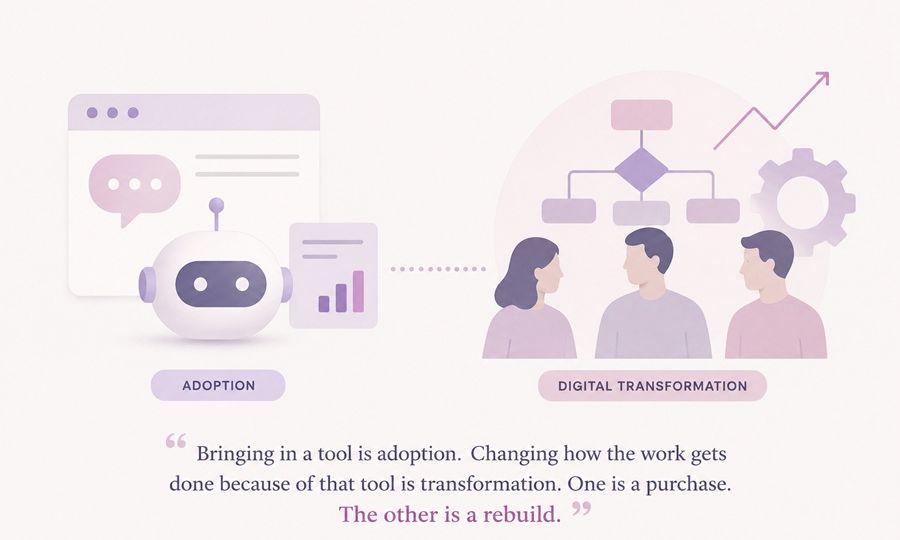
That gap is the whole distinction. Bringing in a tool is adoption. Changing how the work gets done because of that tool is transformation. One is a purchase. The other is a rebuild.
What the Evidence Shows
In July 2025, Project NANDA at MIT released a preliminary report titled “The GenAI Divide: State of AI in Business 2025.” Drawing on interviews with 52 organizations, survey responses from 153 senior leaders, and more than 300 publicly disclosed AI initiatives [2], it found that 95 percent of organizations in its dataset were seeing no measurable return from generative-AI investment, while only around 5 percent of integrated pilots were extracting substantial value. These findings describe the report’s sample, not a universal failure rate for every AI pilot.
The report blames not model quality or regulation but approach, what MIT calls a learning gap: the difficulty of integrating AI into a company’s workflows, structures, and culture [2].
That points to where the effort has to go. Boston Consulting Group, drawing on its own AI transformations across dozens of industries, recommends an allocation it calls 10-20-70: roughly 10 percent of effort on algorithms, 20 percent on technology and data, and 70 percent on people and processes [3]. The claim is not that algorithms determine only a tenth of success. It is that the people-and-process work is what makes a change stick, and it is what companies most often underfund.
As a developer, I find that ratio a useful corrective. Algorithms are my job, but they are the smaller share of what makes any of this work. Most companies get the emphasis backwards, pouring resources into the model and assuming the rest will sort itself out.
Which People?
“People and processes” is vague, and vagueness is how good advice turns into nothing. If most of the work is people, the question is which people.
Consider the cautionary case first. IBM built Watson Health partly through four healthcare-data acquisitions costing approximately four billion dollars. Its healthcare and oncology ambitions then struggled on several fronts: reporting documented technical limits in parsing clinical text, gaps in clinical validation, poor alignment with clinical workflows, and disappointing commercial results [4]. In 2022, IBM sold core healthcare data and analytics assets that formed part of the Watson Health business [5]. The lesson is not that the technology was worthless, but that treating it as the primary variable is how expensive systems end up unused.
Airbus offers a constructive example. Working with Udacity, it created a Digital Academy through which more than a thousand employees completed data analytics and AI and machine-learning programs. Airbus reported a 237 percent return through productivity gains and cost avoidance. The program combined formal training, coaching from data scientists, peer collaboration and work on real Airbus use cases, pairing domain knowledge with technical support rather than asking either side to replace the other [6].
I ran into a version of this myself. A model I had built kept mishandling a certain category of records. The data looked clean and the pipeline, the automated sequence that moves and prepares data for the model, was sound, so I went looking for the bug in my own work. There was no bug. The issue was an internal term whose meaning was specific to that organization and appeared in no documentation, because everyone there already knew it. No amount of debugging would surface it; what did was sitting down with the people who do the work and having them walk me through it.
The knowledge was not missing; it was just not written down anywhere I could reach. Domain experts bring essential operational context but may lack technical tooling; AI specialists bring technical capability but may lack the same depth of organizational context. Technical skills can often be developed faster than the judgment accumulated through years of experience. That is why the 70 percent is less about change-management workshops than about who gets to hold the problem.
The obvious objection is to hire people who have both. They exist, but they are scarce, expensive, and do not scale. The more durable answer is to train the people you already have.
How Governments Are Approaching It
Public institutions making progress have applied a related principle: local and domain knowledge must be built into AI programs rather than added afterwards.
Estonia runs its government AI strategy under a plan nicknamed Kratt, after a folklore creature that does its master’s chores. The AI and Data Action Plan for 2024 to 2026 carries a state commitment of about 85 million euros [7]. By May 2026 it had documented over 220 public-sector AI use cases, with close to 60 million euros in estimated annual impact. Roughly 37 percent of public servants now use AI in their work, and the government projects saving around 21 million hours of administrative work a year by 2030 [8]. A separate education initiative, AI Leap, launched in 2025 to give tens of thousands of students and thousands of teachers structured access to AI tools [9]. Estonia is teaching the people who already run the country to use AI, not just buying it and hoping.
Singapore took a related route with SEA-LION, an open-source language model, one whose code and weights are published for anyone to inspect and adapt, built to perform across eleven or more languages used across Southeast Asia. It sits under the National Multimodal LLM Programme, a two-year national effort of roughly 70 million Singapore dollars [10]. According to AI Singapore’s Leslie Teo, a lean team of about twenty Singaporeans cleaned and evaluated the training data by hand, working with native speakers so the model reflected the region rather than a translation of it [11].
Airbus, Estonia and Singapore illustrate different versions of the same principle: people who understand the work, institution or language must shape the system alongside AI specialists.
A Test for Transformation
This suggests a simple test for anyone claiming to have transformed rather than merely adopted. Which workflow actually changed? Who owns the redesigned process? Which KPI moved, and by how much? And how is feedback captured after deployment, so the system keeps improving instead of quietly degrading? A genuine transformation can answer all four; an adoption usually cannot answer any.
The hardest part of my job has never been building the model; models are often the comparatively tractable part. The hard part is getting the model and the people who understand the work to function as one thing instead of two. That gap is less a technical problem than a translation problem, and it does not close by hiring more engineers or buying a better model. It closes when the person who has spent fifteen years learning how claims get processed, or how aircraft get designed, or how citizens walk into a government office, learns enough AI to see what has become possible.
So when someone tells you their company has adopted AI, do not ask what they bought.
Ask what changed.
References
[1] IDC (2024) Worldwide Spending on Digital Transformation Is Forecast to Reach Almost $4 Trillion by 2027, According to New IDC Spending Guide. International Data Corporation. Available at: https://www.businesswire.com/news/home/20240530917191/en/ (Accessed: 14 July 2026).
[2] Challapally, A., Pease, C., Raskar, R. and Chari, P. (2025) The GenAI Divide: State of AI in Business 2025. Project NANDA, MIT. Preliminary report. Available at: https://mlq.ai/media/quarterly_decks/v0.1_State_of_AI_in_Business_2025_Report.pdf (Accessed: 14 July 2026).
[3] Boston Consulting Group (2024) The Leader’s Guide to Transforming with AI. BCG. Available at: https://www.bcg.com/featured-insights/the-leaders-guide-to-transforming-with-ai (Accessed: 14 July 2026).
[4] Strickland, E. (2019) ‘How IBM Watson Overpromised and Underdelivered on AI Health Care’, IEEE Spectrum. Available at: https://spectrum.ieee.org/how-ibm-watson-overpromised-and-underdelivered-on-ai-health-care (Accessed: 14 July 2026).
[5] IBM (2022) Francisco Partners to Acquire IBM’s Healthcare Data and Analytics Assets. IBM Newsroom. Available at: https://newsroom.ibm.com/2022-01-21-Francisco-Partners-to-Acquire-IBMs-Healthcare-Data-and-Analytics-Assets (Accessed: 14 July 2026).
[6] Airbus and Udacity (2022) ‘Airbus talent reaches new heights with Udacity partnership’. PRNewswire, 7 December. Available at: https://www.prnewswire.com/news-releases/airbus-talent-reaches-new-heights-with-udacity-partnership-301696292.html (Accessed: 14 July 2026).
[7] ERR News (2024) ‘Estonia to invest 85M euros in boosting AI uptake across public, private sectors’. Available at: https://news.err.ee/1609250613/ (Accessed: 14 July 2026).
[8] e-Governance Academy (2026) ‘What it takes to get AI working in government: Lessons from Estonia’ (interview with Ott Velsberg, Chief Data Officer of Estonia), 27 May. Available at: https://ega.ee/ai-working-in-government-lessons-from-estonia/ (Accessed: 14 July 2026). Public-sector AI adoption (37 percent) and the projected 21-million-hour annual saving by 2030 are reported in: The Mandarin (2025) ‘Been there, done Kratt: An AI lesson from Estonia’ (interview with Ott Velsberg), 29 September. Available at: https://www.themandarin.com.au/299752-ai-artificial-intelligence-lessons-estonia-kratt/ (Accessed: 14 July 2026).
[9] Ministry of Education and Research, Estonia (2025) Estonia Announces National Initiative ‘AI Leap’ to Bring AI Tools to Schools. Available at: https://www.hm.ee/en/news/estonia-announces-groundbreaking-national-initiative-ai-leap-programme-bring-ai-tools-all (Accessed: 14 July 2026).
[10] Infocomm Media Development Authority (2023) National Multimodal LLM Programme. IMDA. Available at: https://www.imda.gov.sg/how-we-can-help/national-multimodal-llm-programme (Accessed: 14 July 2026).
[11] CDOTrends (2024) ‘Singapore Wants to Train Its SEA-LION AI Model Ethically’ (quoting Leslie Teo, Senior Director for AI Products, AI Singapore). Available at: https://www.cdotrends.com/story/3940/singapore-wants-train-its-sea-lion-ai-model-ethically (Accessed: 14 July 2026). The manual data curation process is independently confirmed in: Computer Weekly (2024) ‘Sea-Lion explained: Southeast Asia’s first large language model’. Available at: https://www.computerweekly.com/feature/Sea-Lion-explained-Southeast-Asias-first-large-language-model (Accessed: 14 July 2026). The specific team size of approximately twenty people is reported in the CDOTrends interview only and has not been independently verified in official AI Singapore documentation.