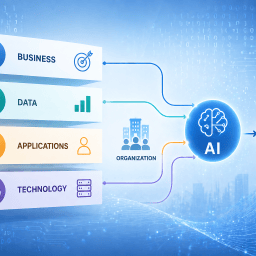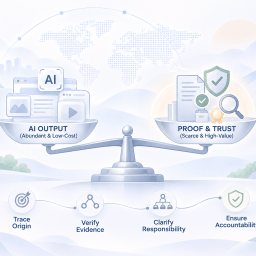
Over the past few decades, the use of Artificial Intelligence (AI) in organisations has increased significantly, especially in HR departments. Could this be a sign that HR professionals will eventually be replaced by AI? Will businesses no longer need HR experts, or will AI help develop and evolve their profession and role within organisations?
A key assumption of the ILO paper (2025) is that every job consists of a bundle of tasks. Therefore, the fact that some activities can be automated does not necessarily mean that the entire job will disappear. The impact of AI depends on the percentage of tasks that can be automated, how important these tasks are to a particular job, and the extent to which human skills, critical thinking and involvement are still needed.
Until recently, the role of HR professionals in organisations was more traditional. It mainly focused on administrative, bureaucratic and repetitive tasks, such as conducting interviews, processing new hires, onboarding new employees, screening CVs, and so on. AI is changing this situation through the introduction of AI-supported workforce management systems (such as LinkedIn, SAP system). Many of these repetitive HR tasks can now be performed efficiently and effectively by such systems. So, what will the role of HR professionals be from now on? Are we asking them to become IT experts? Apparently, this is not the case.
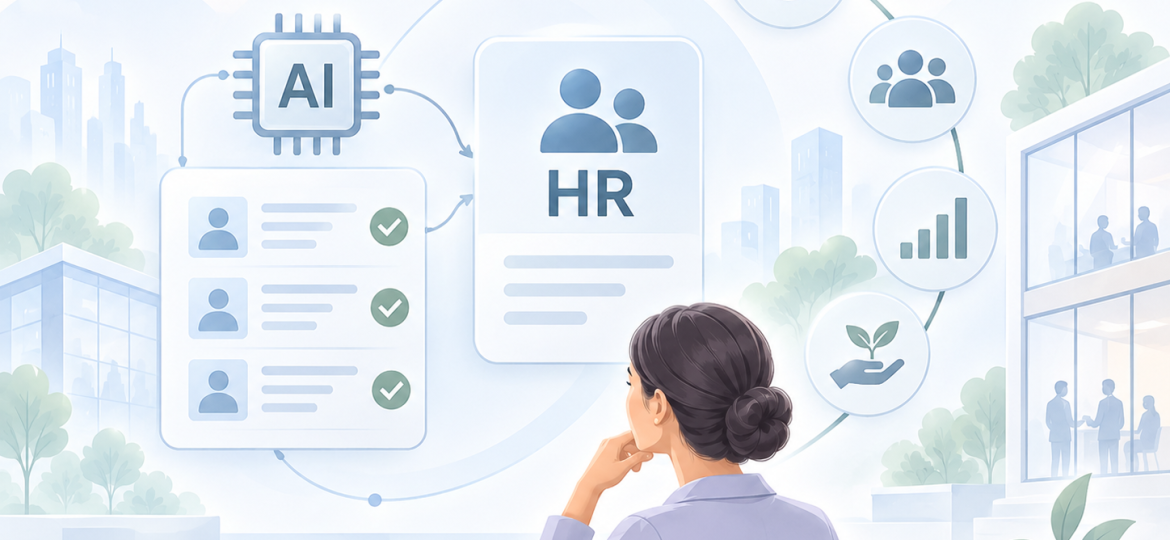
The introduction of AI creates two parallel developments. On the one hand, it automates repetitive administrative tasks that add relatively little value. On the other hand, it gives HR professionals more opportunities to focus on more complex, strategic and people-centred activities (such as employee relations and conflict resolution, coaching, mentoring, and career counseling, supporting employee wellbeing and mental health initiatives etc.). However, there is a contradiction here: organisations mainly adopt AI to improve efficiency, reduce costs and simplify processes. Nevertheless, automation is often what creates the time and space that HR professionals can use to develop their role further. They need to take this opportunity and convert their work by moving towards a more strategic and people-centred role within the organisation, while moving away from their traditional role and its responsibilities.
The strategic role of HR professionals expects them to act as Strategic Business Partners to Management. This means moving away from simply carrying out tasks related to the day-to-day management of employees and focusing more on how to make the best use of employees’ skills and how to develop them in order to achieve the organisation’s strategic goals. This more advanced role includes activities such as strategic talent management, strategic workforce planning, performance management and development, and strategic skills development.
This modification is directly connected to the evolution of HR, from managing people and existing job roles to helping design a new working environment. The role of HR will no longer be limited to predicting the impact of technology or managing organisational changes. Instead, it will also involve redesigning jobs and individual tasks, identifying the skills that will be needed in the future, supporting employees through career transitions, and ensuring that human-AI collaboration improves productivity without reducing the value of human contribution. In this sense, HR professionals are expected not only to decide which people will perform which tasks, but also which tasks will be handled by AI, how the two will work together, and how human judgement, autonomy and employee development will be maintained.
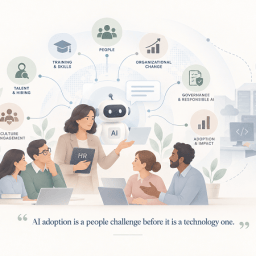
In order for technology and HR to work together in a way that supports the development and growth of the HR profession, professionals need to develop new skills. These include AI knowledge, digital and data literacy, critical thinking, and the ability to work effectively with technology. Equally important are the knowledge and skills HR experts need to manage issues such as transparency, data protection, algorithmic bias, and maintaining human oversight in decisions that affect employees.
It therefore becomes clear that effective human-AI collaboration depends on how tasks, processes and decision-making responsibilities are designed. Special attention should be paid to ensuring that the use of AI does not limit the development of human skills, but instead complements them and supports professional growth. The future of HR work will not be determined only by which tasks AI can perform, but mainly by the decisions organisations make about how roles, skills and working conditions will be redesigned around this technology. AI creates opportunities, but HR has the responsibility to help design a working model that uses these opportunities in a productive, fair and people-centred way.
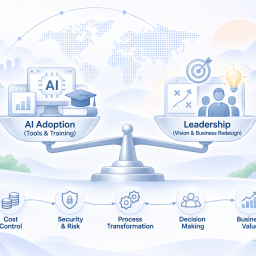
In conclusion, the human factor remains essential and necessary in organisations. AI can help the HR profession evolve, allowing HR professionals to take on a more central and active role within the workplace ecosystem. They can become not only users of AI, but also responsible guardians of how it is used. The future of HR will not belong to the leaders who simply adopt the most AI tools. It will belong to those who understand how technology, people and organizational purpose can work together. The HR Manager of the future will not simply manage employees. They will design the conditions in which people and AI can perform at their best.
———
References
- Kalff, Y., & Simbeck, K. (2026). AI-augmented human resource management? Insights from German companies. arXiv. https://arxiv.org/abs/2607.13839
- Doshi, A. R., & Moore, A. P. (2025). Toward a human–AI task tensor: A taxonomy for organizing work in the age of generative AI. In The handbook of AI and strategy. Edward Elgar Publishing.
- Gmyrek, P., Berg, J., Kamiński, K., Konopczyński, F., Ładna, A., Nafradi, B., Rosłaniec, K., & Troszyński, M. (2025, May). Generative AI and jobs: A 2025 update. International Labour Organization.