1. A Smart Factory That Can Still Forget
Smart manufacturing has stopped being a side experiment. In Deloitte’s 2025 survey of 600 executives at large US manufacturers, 29% reported using AI at facility or production-network level, and 92% expected it to be their main competitive driver within three years.¹
The frontier is already visible. By June 2026, the World Economic Forum’s Global Lighthouse Network had grown to 238 advanced manufacturing and supply-chain sites.² CATL’s Liyang battery plant is one, already running computer vision and deep learning across its lines.³
Yet even an advanced and highly connected factory can still forget.
In Serra-Perello and Ortiz’s experiments, fine-tuning with no stored examples produced average forgetting scores of 31.09 on Core 50/2 and 40.06 on CIFAR-100.⁴ In plain terms, the models lost roughly 30 to 40% of what they could previously recognise. Those are laboratory figures, not industrial failure rates, but the hazard is real.
The next phase of Industry 4.0 is the factory that learns without forgetting.
2. Industry 4.0’s Static-Intelligence Problem
That is the failure inside the model; the second sits outside it, because the factory never stops moving. Most industrial AI follows a static lifecycle: teams gather data, train and validate a model, then deploy it to detect defects or emerging failures, and retrain when performance deteriorates.
A factory is never the fixed system the training data assumed. Machines wear, tooling and suppliers change, new variants enter production, and operating conditions such as temperature, lighting, vibration or line speed gradually shift, pulling live data away from the distribution the model trained on. Predictive-maintenance research describes precisely this: a model fitted to the plant under one set of conditions loses its ability to generalise as those conditions evolve.⁵
A plant can monitor continuously without learning continuously. Sensors stream round the clock while the model beneath goes untouched for months. Industry 4.0 made factories observable. It did not make them able to keep each new lesson.
3. What Continual Learning Actually Means
Continual, or incremental, learning lets a model acquire new tasks, defect categories or conditions sequentially, rather than being rebuilt after every change. Its defining obstacle has a name: catastrophic forgetting.⁶ Adapting to new data, a model overwrites the weights that made it effective on the old.⁷
Consider a vision system trained on scratches, cracks and alignment defects for one product line. When a new product arrives, it must learn those defects without losing the older ones still on the line.
Plasticity is the capacity to absorb what is new; stability is the capacity to keep what works. Too much stability calcifies the model; too much plasticity makes it forget, and the damage stays hidden until a rare old fault reappears and the system fails to react.
Serra-Perello and Ortiz catalogue nine families of methods, but in practice they reduce to four core strategies:⁸
- Remember and rehearse: retain representative examples of earlier defects and revisit them in later updates.
- Protect critical knowledge: limit changes to components that remain important to earlier tasks.
- Transfer previous behaviour: use the old model as a reference for the new one.
- Add capacity: introduce specialised modules for new conditions rather than rewriting the same model.
Storage, privacy and plant constraints mean no approach fits every factory.⁹
4. How a Factory Develops a Memory
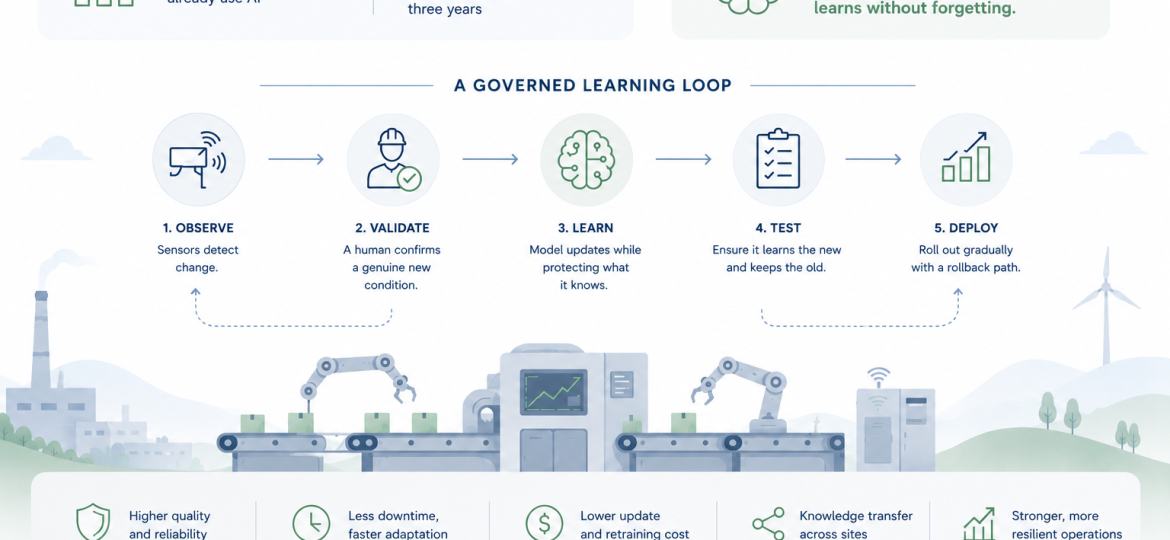
So how does a factory choose? Less by picking the perfect algorithm than by building a governed loop joining plant data, human judgement, model updates and line control.
It starts with observation: sensors, cameras, maintenance logs and quality systems record what the line does, and the loop flags change: a new vibration signature, an unfamiliar defect, a slow slide in quality. A human validates the event before anything is learned.
A vision system alerts on a batch of parts. Genuine new crack, or did a coolant splash smear the lens? A vibration channel spikes overnight. New bearing fault, or a loose sensor mount rattling on its housing? The technician checks the signal against the asset, pulls the part, reseats the probe, checks the maintenance record. Only after a person confirms a genuine new condition, not bad data, a sensor fault or a one-off anomaly, does it become training material. Skip that gate and you teach the system the wrong lesson.
Once validated, the model learns selectively, protecting what it knew about older machines, products and faults. The loop tests it twice: that it grasps the new situation, and has not dropped an old one.¹⁰ The new version rolls out gradually, with a clean path back if performance slips. Governance belongs inside this loop rather than after it: every pass is versioned, tested and reversible by design.
Running it takes three roles, not a new department: the technician who validates events, an engineer who owns retraining and retention tests, and a quality lead who signs off releases.
A recent prototype shows this end to end. Built for quality control in a Spanish cheese factory, it combined streamed data, human validation, model versioning, on-device incremental learning and process optimisation. It was simulated on real factory data and industrial software, not deployed live.¹¹
5. What Already Exists and What Continual Learning Could Add
Few manufacturers report fully autonomous, self-updating systems; the capability is emerging rather than production-proven, and the cheese-factory loop above was a simulation, not a live deployment. What many possess is the groundwork: connected infrastructure, industrial AI and the data on which a memory-enabled system could sit.
In France, Schneider Electric’s Le Vaudreuil plant uses Industrial IoT sensors and digital platforms whose rollout cut energy use by 25%, material waste by 17% and carbon emissions by 25%.¹² In the United States, GE’s SmartSignal applies predictive analytics and digital twins to catch developing equipment problems, with GE reporting that some customers achieved a return on investment within three months.¹³ In China, CATL’s Liyang plant pairs micron-level inspection with deep learning for process control and energy management; the World Economic Forum reported a 320% rise in output, a 33% cut in manufacturing cost and a 99% cut in quality defects.¹⁴
The cited sources do not establish that these systems already use fully autonomous continual learning in production. Each could gain a memory: maintenance models adapting as equipment ages, baselines evolving with load, new defects absorbed while older safety-critical ones stay. Continual learning would add its memory.
6. From Model Accuracy to Operational Memory
The prize is wider than accuracy: shrinking the gap between a new event and a reusable lesson. In predictive maintenance that means catching emerging failures earlier, retraining in full less often, and carrying knowledge across machines, product generations and sites.¹⁵
The scorecard changes: accuracy alone will not show whether the plant is getting smarter. The metrics that matter are operational: how fast a validated incident reaches the live model, how much failure knowledge survives an update, how far unplanned downtime falls, what an update costs, and how much learning transfers between sites. Of these, knowledge retention and time-to-deployment show most directly whether the plant is learning; cost and downtime validate the business case. Transfer runs through a shared model registry or federated updates, where plants exchange improvements rather than raw production data.
The cost profile is unusual: most spend goes not on models or hardware, since the sensing layer is usually installed already, but on the validation, versioning and testing around it. The financial value of predictive analytics is on record.¹⁶ The task is turning isolated wins into knowledge the organisation keeps.
7. Learning Must Remain Governed
A factory that learns continuously cannot change without control. A mislabelled part, a failing sensor or a freak event can each teach the wrong lesson, and an update chasing new conditions can erase a rare but safety-critical fault.
Manufacturers must therefore govern it as an industrial process, not release it as an autonomous retraining mechanism. That means human validation, version control, retention testing, rollback and auditability. In regulated sectors such as pharmaceuticals and automotive, each model version is a controlled change, so updates must be documented and revalidated, not continuous. Continuous updating also widens the attack surface: a compromised sensor becomes a route to poisoning the model, one more reason to keep validation human and versions reversible.
The JAIR study reinforces the need for context-specific governance. Results vary with the scenario and the availability of memory: distillation-based methods often perform strongly, exemplar-replay methods benefit from stored examples.¹⁷ No universal best method means no universal autopilot. The loop must stay supervised and reversible, without opaque or uncontrolled retraining.
8. The Factory as a Learning System
The next industrial advantage will not come from more sensors or data lakes, but from turning experience into knowledge the plant reuses without erasing what it learned.
A genuinely intelligent factory is not merely connected or predictive. It adapts, remembers and improves without eroding what remains valuable. One kind of factory collects information. The other turns experience into memory, and keeps it.
References
¹ Deloitte, “Deloitte Survey Reveals Smart Manufacturing Is Driving Advantage but Needs Focused Investment and Implementation”, Deloitte Smart Manufacturing and Operations Study, 2025
² World Economic Forum, “New Global Lighthouse Sites Demonstrate How AI Is Rewiring Manufacturing and Supply Chains”, WEF, 2026
³ World Economic Forum, “CATL – Liyang: Global Lighthouse Network Case Study”, WEF, 2023
⁴ SERRA-PERELLO, M., ORTIZ, A., “Incremental Learning Methodologies for Addressing Catastrophic Forgetting: Analysis and Experimental Evaluation”, Journal of Artificial Intelligence Research, vol 83 (2025), DOI: 10.1613/jair.1.18405
⁵ HURTADO, J. and others, “Continual Learning for Predictive Maintenance: Overview and Challenges”, Intelligent Systems with Applications, vol 19 (2023)
⁶ McCLOSKEY, M., COHEN, N. J., “Catastrophic Interference in Connectionist Networks: The Sequential Learning Problem”, The Psychology of Learning and Motivation, vol 24 (1989) 109–165
⁷ Serra-Perello and Ortiz (n 4)
⁸ Idem
⁹ Idem
¹⁰ Idem
¹¹ GARCÍA-SANTACLARA, P., FERNÁNDEZ-CASTRO, B., DÍAZ-REDONDO, R. P., CALVO-MOA, C., MARIÑO-BODELÓN, H., “Continual Learning at the Edge: An Agnostic IIoT Architecture”, arXiv preprint arXiv:2512.14311 (2025). The paper presents a modular continual-learning architecture for industrial quality control, validated through a simulation using an edge device and real production data from the Spanish cheese manufacturer Quescrem
¹² World Economic Forum, “Factories of the Future Call for Responsible Scaling That Prioritizes the Planet and People”, WEF, 2022
¹³ GE Digital, “SmartSignal Digital Twin Solution Enables Industrial Companies to Predict, Diagnose, Forecast and Prevent Downtime”, 2021. GE reports that some customers achieved return on investment within three months
¹⁴ World Economic Forum, “CATL – Liyang” (n 3)
¹⁵ Hurtado and others (n 5)
¹⁶ GE Digital (n 13); World Economic Forum, “CATL – Liyang” (n 3)
¹⁷ Serra-Perello and Ortiz (n 4) s 6